

Developed in partnership with our Scientific Leadership Council (SLC) of interdisciplinary experts
Research indicates the severity of social disconnection, but we lack a roadmap to help individuals, communities, and society at large become more connected and less socially isolated and lonely. Our Systems Approach of Cross-sector Integration and Action across the Lifespan (SOCIAL) Framework facilitates and accelerates progress toward a society that values social connectedness across the lifespan and in all societal domains.
The SOCIAL Framework works to:
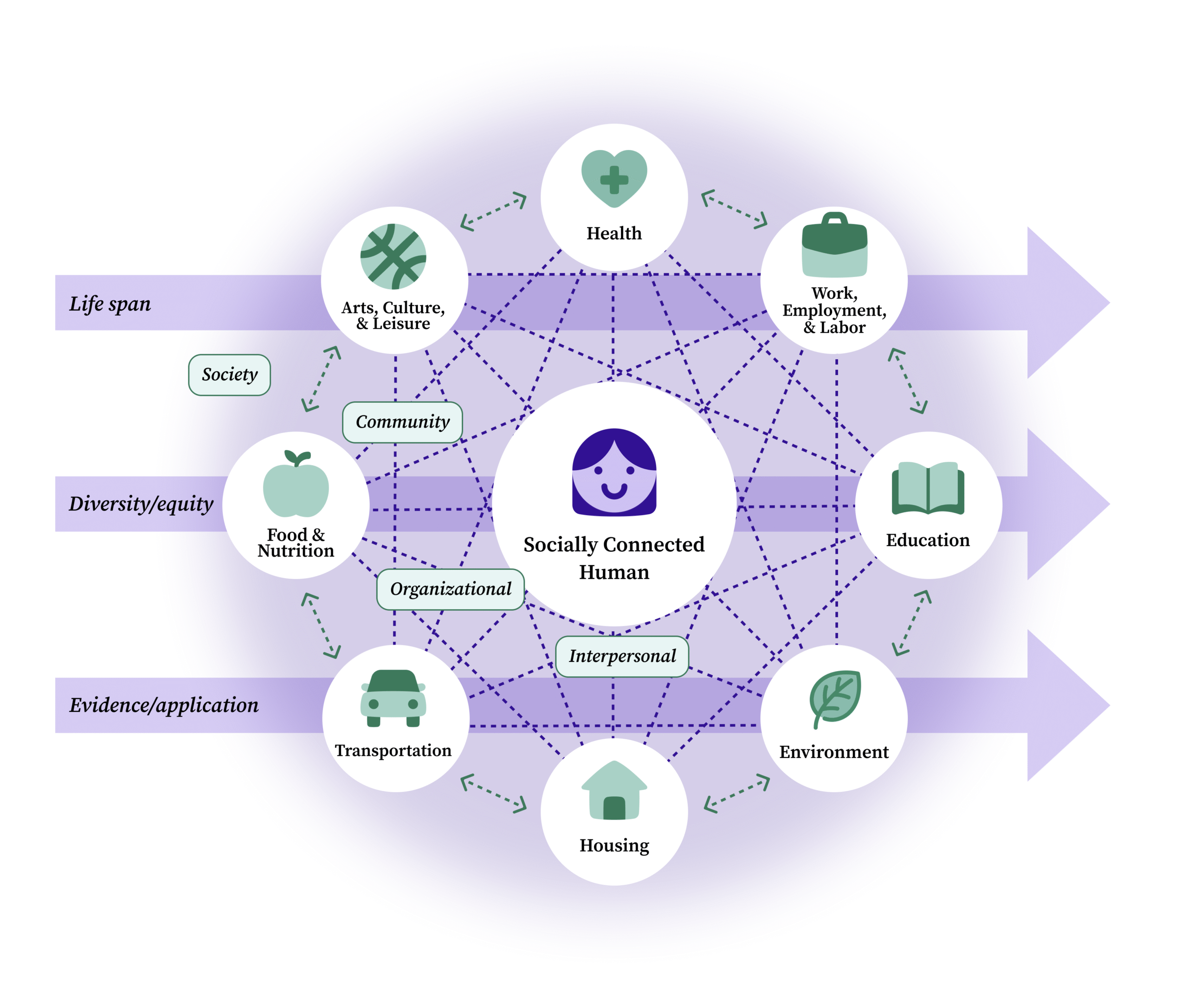
In a socially connected community:
• Children are taught social and emotional skills in schools;
• Individuals are employed by workplaces that support the connectedness of their employees;
• Daily systems that are integral to our lives such as food and transportation, and the environments and neighborhoods in which we live, are intentionally designed to foster social connection.
This is a result of society and policies reflecting the significance of connectedness for our collective health and wellbeing.
Review our research on each sector below

Clinical and population health provide touchpoints to identify individuals who are socially disconnected and provide them with the resources and support they need.

Our experiences in early educational settings influence the development of our social skills and feelings of belonging. These experiences shape our abilities to form meaningful social connections throughout our entire lives.

American adults spend on average a third of their lives at work. Since we spend so much time at work, there are key opportunities for social connection.

Research highlights the critical role of well-designed, intentional, and inclusive spaces in addressing social isolation, loneliness, and connection. By prioritizing human-centric design, such spaces become catalysts for community engagement and social integration.

Food goes far beyond nourishment for our body and mind—it’s also a powerful tool for connection. What we eat, where we get it from, and how we gather around it are all opportunities for social relationships to begin and thrive.

The arts, culture, and leisure sectors play an important role in shaping the social environments where connection can grow and endure. Rather than functioning only as isolated activities or programs, these sectors often provide ongoing settings where people gather, participate, and interact over time.
A brief overview of how the Foundation is putting the framework into action:
Drawing upon our latest SOCIAL Framework report, we dove into how arts, culture, and leisure can be leveraged to strengthen social connection and improve both individual and community outcomes.
Featuring a fireside chat with experts who contributed to the report, we discussed actionable strategies and real-world examples for advancing social connection through systems change and community engagement. We also highlighted the importance of designing these opportunities with intention, addressing barriers to access, and ensuring equitable participation so that social connection is fostered across diverse communities.
Whether you are an artist, cultural leader, policymaker, educator, public health professional, philanthropist, or community advocate, this webinar invites you to reimagine arts, culture, and leisure not as peripheral, but as central to building more connected, inclusive, and resilient communities.