
June 18, 2026
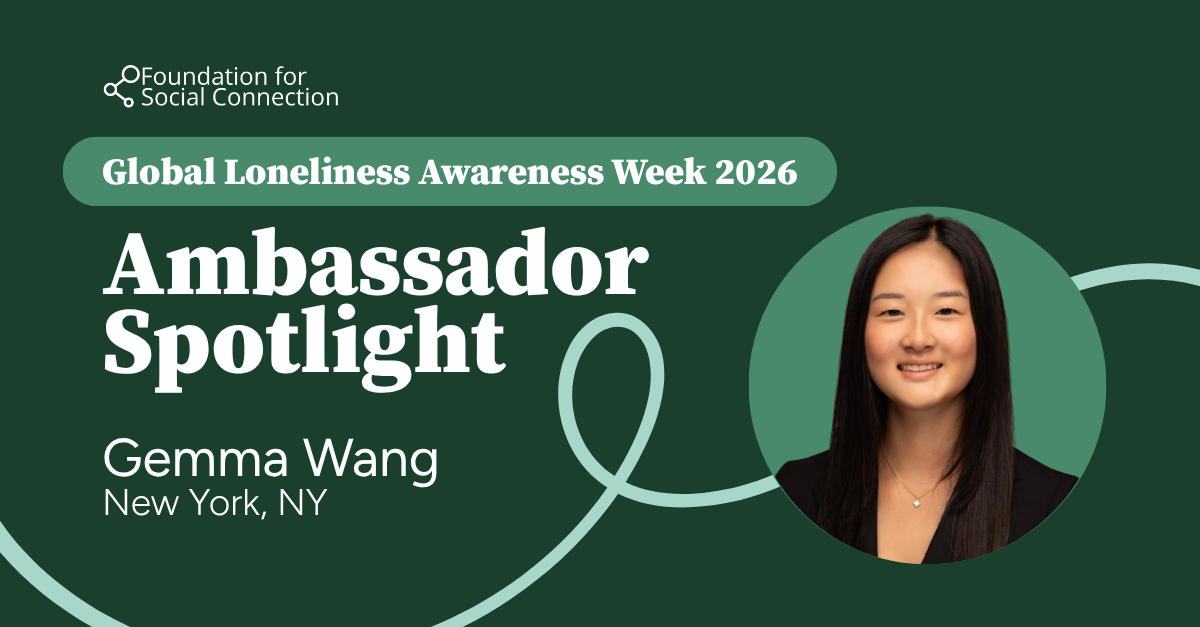
By: Gemma Wang, F4SC Ambassador
When I was fifteen, I thought I was volunteering to share music.
I had been playing piano for over ten years, and this time, I wanted my music to mean something more than another recital or competition. I began visiting assisted living facilities because I hoped that a familiar melody might bring residents comfort and joy, especially since many lived miles away from their loved ones. What I didn’t expect was that those visits would fundamentally reshape how I understood loneliness, connection, and even aging.
At first, I focused on the music, like I always had. Very quickly, however, I realized that the most meaningful moments unfolded after the final note, when music ceased to be a performance and became an invitation. A resident would share a story about their parents or children from decades ago. Someone who had sat quietly throughout the performance would suddenly begin laughing and clapping. A song would unlock a memory, and a memory would spark a conversation. I began to notice that silence often mirrored loneliness, and that connection, rather than just performance, was what people were truly seeking.
Carrying those conversations with me long after each visit ended, I founded The Melody Project, a 501(c)(3) youth-led nonprofit that connects students and older adults through music, conversation, and creative activities. Since then, our organization has had the privilege of impacting the lives of more than 500 older adults and younger students internationally, with every interaction reinforcing the same lesson: meaningful connection is not a luxury. It is a fundamental human necessity.
Through this work, I’ve come to understand that loneliness is not simply about physically being alone. Some of the loneliest people I have met, whether they are residents in a facility across the street from my apartment or a schoolmate and friend, are constantly surrounded by others every day. Loneliness, at its core, is not the absence of people but the absence of belonging: the feeling of being unseen, unheard, and disconnected from meaningful relationships. At the same time, connection does not always require grand gestures. Sometimes it can begin with a simple question, a shared memory, or simply taking the time to listen.
One moment from my work with The Melody Project that has stayed with me involved a resident named Fran. During a bracelet-making activity inspired by music and memory, she sat quietly while others talked. When I shared a personal story about my own family, she slowly picked up a few blue beads and told me that blue had been her mother’s favorite color. Then she began reciting a childhood poem her mother used to read to her, entirely from memory. What struck me wasn’t simply the memory itself, but the fact that it had been waiting there all along, surfaced only because someone took the initiative and time to listen. Behind every quiet exterior is a lifetime of stories waiting for the right invitation.
What has surprised me most is how universal loneliness really is. While older adults are certainly at higher risk, I’ve since realized that my own generation is struggling too. Many young people are more digitally connected than any generation before them, yet often feel profoundly alone. I’ve watched friendships form between teenagers and residents separated by sixty or seventy years in age, only to discover that they share many of the same fears, hopes, and desires to belong. Loneliness is not an age-specific challenge. It is a human one.
Still, I am hopeful about the momentum I am seeing around me. Around the world, there is growing recognition that social connection is a public health issue, not just a personal one. Researchers, healthcare providers, policymakers, educators, and community organizations are increasingly recognizing that belonging cannot be treated as an afterthought; it must be intentionally woven into the systems we build. I am especially encouraged by the rise of intergenerational initiatives that bring people together across age groups rather than allowing generations to become isolated from one another. Through organizations like the Foundation for Social Connection and many others, conversations that once seemed niche are becoming part of a broader movement.
My hope for the future is that we begin treating social connection with the same seriousness that we afford other determinants of health: not merely as a personal concern, but as a public priority worthy of investment, research, and policy action. We would never tell someone to ignore nutrition or exercise, and connection deserves that same attention. I hope we continue investing in community-based programs, supporting research that measures their impact, and creating spaces where people can build meaningful relationships across generations, communities, and lived experiences.
Most importantly, I hope more people realize that they do not need special credentials or authority to make a difference. The Melody Project began with a piano, a few high school students and friends, and a willingness to show up. Addressing loneliness does not always require sweeping policy changes or massive resources. Sometimes it starts with a conversation, an act of curiosity, or the decision to reach out to someone who may be feeling alone.
Connection is built one conversation, one act of curiosity, and one relationship at a time. The good news is that every one of us has the power to begin.
About our ambassador, Gemma
Gemma Wang is a 10th-grade student passionate about the intersection of human connection, evidence-informed policy, and cutting-edge research. As a lifelong pianist, she has always understood connection through music: a language capable of bridging generations, sparking memory, and restoring belonging. This belief inspired her to create The Melody Project, a nonprofit that combats loneliness among older adults through cognitively and emotionally engaging music-inspired activities. This initiative has grown into a citywide intergenerational effort that has reached over a hundred residents and empowered students to transform empathy into meaningful service. At the core of her work is the firm belief that policy, empathy, and research are inseparable as they are dependent on each other. As such, she has taken extracurricular public policy courses, conducted university-level bioinformatic research under PhD candidate mentorship, presented my nonprofit work at the Gerontological Society of America’s Annual Scientific Meeting, and published an article on the importance of social-interaction-based interventions in the American Society on Aging’s Generations Now publication. She has also become engaged in civic dialogue and youth leadership. As a facilitator in her school’s deliberation lab and her school’s delegate to the upcoming NAIS Close Up Conference, she helps students practice constructive conversation across difference, a skill that strengthens social cohesion. As a young woman in an increasingly polarized world, she is committed to creating spaces where empathy fuels innovation and young people’s voices contribute to social change. She hopes to uplift social connection as a public health priority—one story, one melody, and one human relationship at a time.
Learn more about our Ambassador Program here.