
July 31, 2026
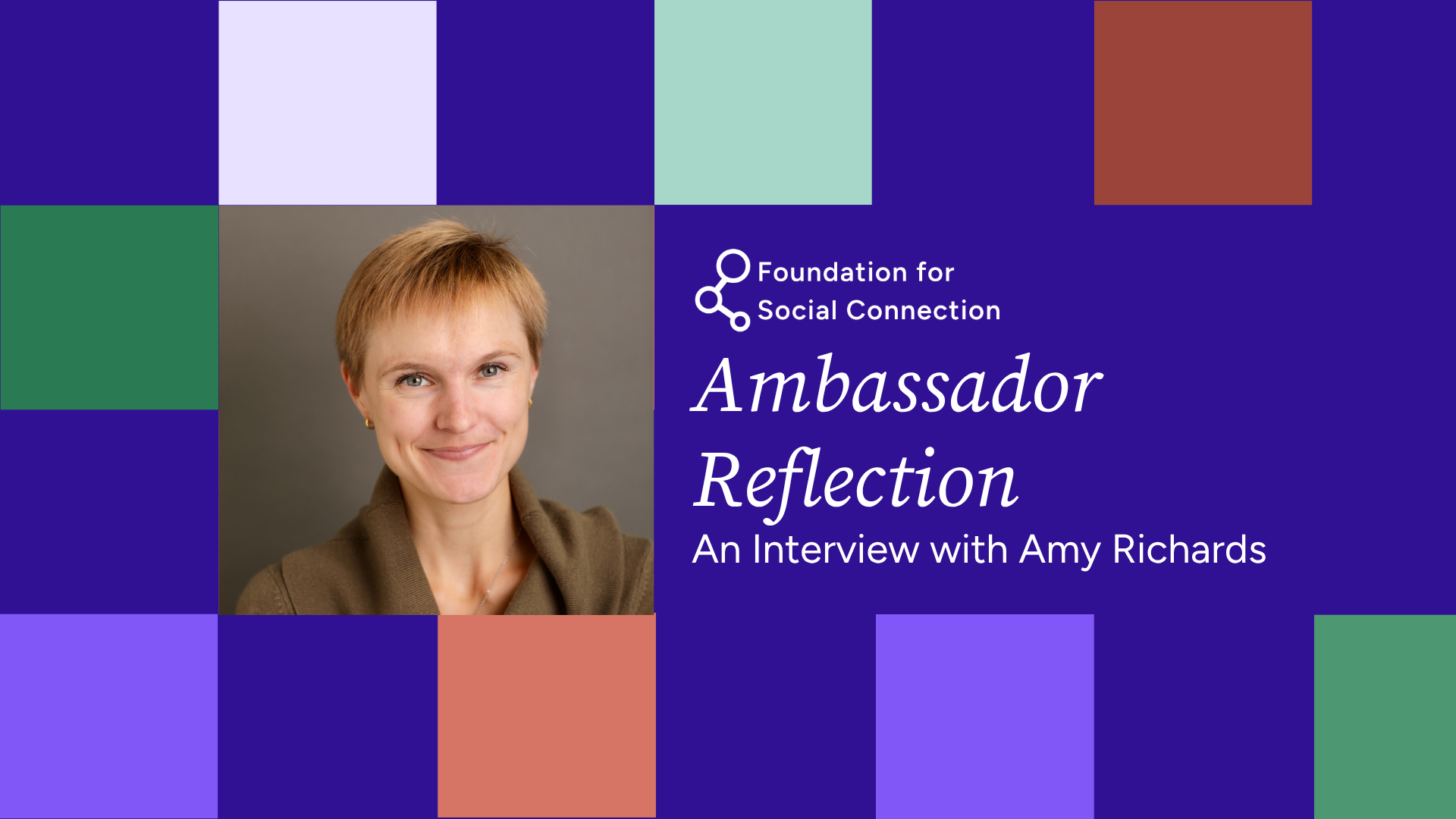
By: Amy Richards, F4SC Ambassador
When people ask how I became interested in social connection, they often expect me to point to a single moment. The truth is, it emerged slowly through experiences that kept asking the same question in different ways: Why do people feel alone, even when they are surrounded by others?
I grew up between California and Utah, watching two very different cultures produce many of the same struggles—loneliness, isolation, exclusion, and even suicide—but through different pathways. I experienced forms of loneliness myself, and over time I began to notice something else: many of the people around me who were struggling with anxiety, depression, or other forms of suffering and dysfunctional yet misunderstood behaviors also carried deep experiences of disconnection. Sometimes that disconnection came from relationships with others. Sometimes it came from losing a sense of belonging or purpose, spiritual grounding, or even connection to themselves.
Those observations eventually led me to public health and anthropology. I wanted to understand not only what improves health, but how people experience their worlds and make meaning within them across societies at large. Along the way, working in public health reinforced a lesson I continue to come back to today: we are often eager to solve problems before we have fully understood them and what human history tells us about them. The most effective work rarely begins with answers. It begins with listening.
That is perhaps what I most wish more people understood about social connection. Loneliness is not simply the absence of social interaction, and connection is not simply the presence of other people. Human relationships matter profoundly, but they are only one part of a much larger picture. We are also connected—or disconnected—from our communities, our institutions, our environments, our identities, our sense of purpose, and our human nature. If we define loneliness too narrowly, we risk overlooking both the richness of people’s experiences and the many pathways through which healing can occur.
This realization has also changed how I think about solutions. Throughout my career, I have seen well-intentioned programs fall short because they were designed around assumptions rather than lived experience. Again and again, I have found that the people living a challenge understand dimensions of it that outsiders cannot easily see. That has strengthened my belief that those closest to a problem should be partners in shaping the response. Social connection cannot simply be delivered pre-packaged; it must be co-created.
One of the most encouraging developments I have witnessed over the past several years is the remarkable growth of this field. When I first began following loneliness research a decade ago, social connection was still a niche conversation. Today, it has become part of discussions in public health, healthcare, education, workplaces, urban planning, and government. Organizations like the Foundation for Social Connection have helped shift the conversation from seeing loneliness as an individual failing to recognizing social connection as something our communities and institutions help cultivate—or erode.
What excites me most, however, is not simply that more people are talking about social connection. It is that we are beginning to ask better questions. We are becoming more curious about how culture shapes belonging, how environments influence wellbeing, and how people themselves define connection in ways that researchers and practitioners might otherwise overlook. I hope we continue moving in that direction with humility, curiosity, and a willingness to challenge our assumptions and work with groups often undervalued for their ability to meaningful contribute.
As I look toward the future, my hope is that social connection becomes less of a standalone initiative and more of a lens through which we approach nearly everything we do. Whether we are designing neighborhoods, schools, workplaces, healthcare systems, or public policies, we should be asking not only whether they are effective, but whether they help people feel that they belong, that they matter, and that they are part of something larger than themselves. Does our context generate understanding, remove invisibility, and provide a sense of being held?
Most of all, I hope we continue listening—to people whose experiences do not fit neatly into our existing frameworks, to communities that already possess wisdom about what helps them thrive, and to one another. If my own journey has taught me anything, it is that deep understanding almost always comes before meaningful change. Social connection begins there.