
July 30, 2026
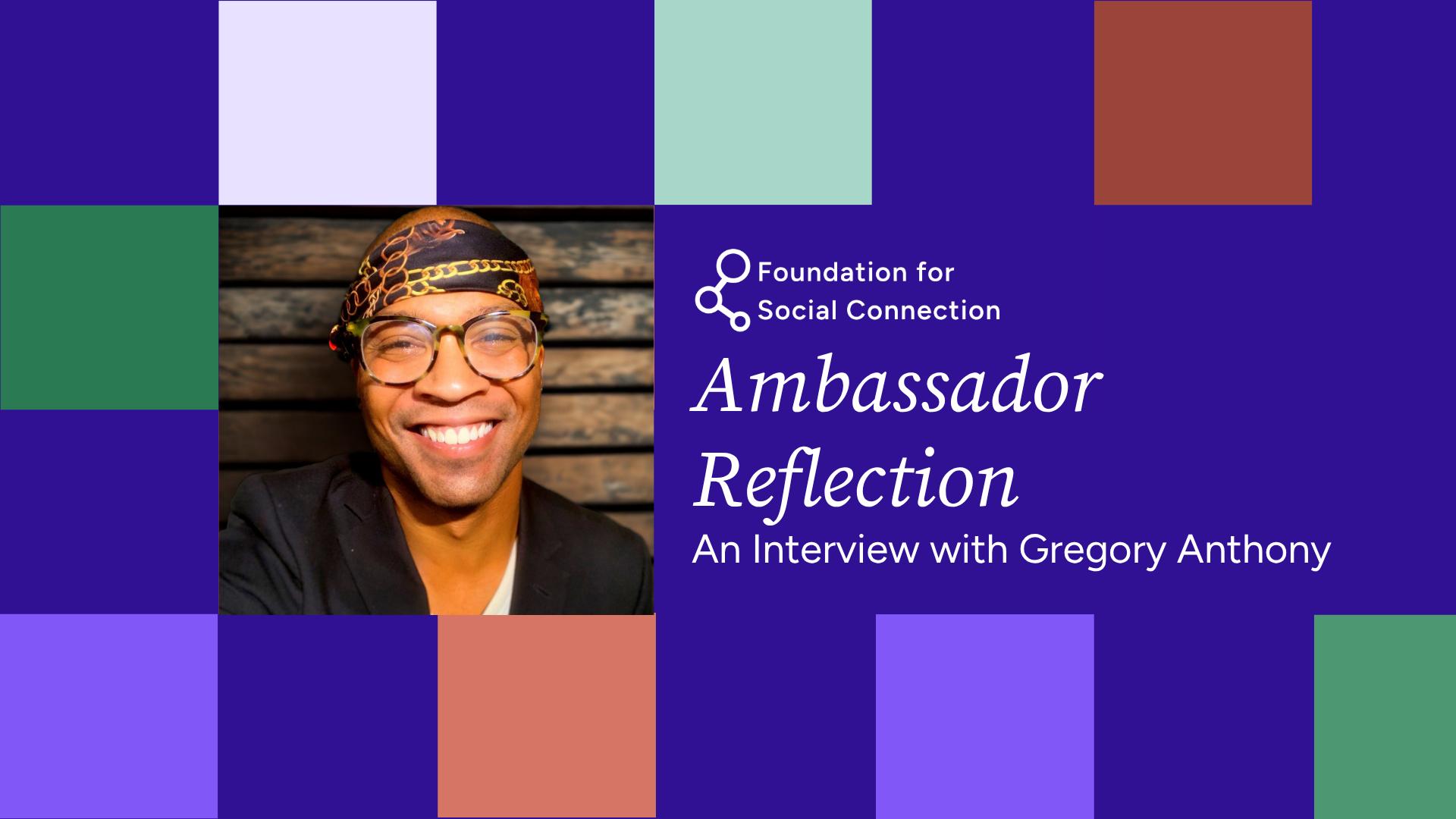
By: Gregory Anthony, F4SC Ambassador
The night Barack Obama was elected, someone hung a noose outside my dorm at Hampden-Sydney College; I chose to organize for belonging rather than retreat. That moment crystallized something I had been feeling but could not yet name: isolation is not accidental, it is engineered, and connection is the most radical act of resistance we have. Navigating housing instability while maintaining my studies sharpened my understanding that social connection is not a luxury; it is survival infrastructure. I have built power with those pushed to the margins: placing unhoused neighbors into jobs at Friendship Place, restoring voting rights for over 100,000 returning citizens in Florida, managing winning campaigns for Dr. T. Michelle Colson and Robert White, mobilizing domestic workers across Virginia with Care in Action, coordinating multistate Election Protection with the Lawyers’ Committee for Civil Rights, training Bridge Builders across North Carolina with Democracy North Carolina, and leading health equity campaigns with Advocates for Justice and Education. Every role taught me that isolation is a policy choice, and connection is the infrastructure that makes liberation possible. I maintain 35 to 40 monthly one-on-one stakeholder engagements because I know that transformation happens in relationship, not in theory. That choice to turn exclusion into collective liberation led me to found Neighborhood Folks, unionize NCS Systems with SEIU Local 500, and join the Foundation for Social Connection as an ambassador; our freedom is collective, and justice is not given, it is organized.
Social connection is not a feel-good add-on; it is the load-bearing infrastructure of every movement for justice, and when we treat it as optional, our organizing collapses under the weight of burnout, mistrust, and isolation. Through founding Neighborhood Folks and building the Seeds of Change Art Collective, I have learned that connection must be designed with the same rigor we bring to policy campaigns or budget fights. We built our Liberatory Community of Practice using a triple-track strategy: Soil (DC), Sea (Caribbean diaspora), and Horizon (Palestine solidarity), synchronized through seasonal movement rhythms that reject extractive colonial timekeeping and center restorative pacing. Our flagship program, the monthly Seat at the Table Continuum of Power and Social Connection, weaves together community listening sessions, diasporic interfaith pluralism dialogue, law talk, and root cause analysis because we understand that connection without structural analysis reproduces harm, and analysis without connection produces isolation. What people need to know is this: social connection is not about making people feel less lonely; it is about building the relational infrastructure that allows communities to govern themselves, resist oppression together, and imagine futures that our current systems say are impossible. When we launched the 51st State of Mind campaign, we were not just advocating for DC statehood; we were demonstrating that everyday people can control budgets, shape policy, and fund care over cages when they have the relational trust and participatory structures to do so. Connection is the condition of possibility for democracy itself.
What has surprised me most is how much our systems depend on isolation to function, and how quickly those systems begin to crack when people build even modest relational infrastructure. When we established our NSIA framework (Neuroinclusion, Social Connection, Intersectionality, Accountability) and began facilitating Culture NSIA circles, I expected resistance from institutions; what I did not expect was how hungry people were for spaces where they could show up whole, where their lived experience was treated as valid policy evidence, and where rest was recognized as resistance rather than weakness. Through our Areíto Evaluation methodology, rooted in Afro-Arawak Taíno values like Guaitiao (relational adoption) and matrilineal care, we have been able to translate storytelling into data that policymakers cannot ignore. The surprise is not that connection heals; the surprise is that connection also reveals. When we brought 50-plus grassroots creatives together through Seeds of Change and began producing work like the Ancestral Liberation Zine, the Dr. Nee Nee Tay mural at the Anacostia Mural Festival, and the MySon Xavier Way collaborations, people started naming harms they had been carrying alone for years. Connection does not just make people feel better; it makes power visible, it makes harm legible, and it makes collective action inevitable. I have also been surprised by how much institutional actors fear this. When we chaired coalition mobilization infrastructure for the July 5, 2026 Right to Learn March on Washington, aligning narrative, logistics, accessibility, and accountability across multi-stakeholder teams, the resistance we encountered was not about our demands; it was about our process. Sociocratic governance, troika leadership circles, and Guani Budgeting as moral documents threatened the very idea that only experts should make decisions. Social connection, when practiced with intention and rigor, is a direct challenge to every system that depends on our isolation to maintain control.
The most significant momentum I am seeing is the growing recognition that social connection is not separate from material conditions; it is inseparable from housing justice, labor rights, healthcare access, and democratic participation. My recent induction into the inaugural cohort of the Center for Popular Democracy’s Storytellers Institute and my work with the Washington DC Pluralism Academy have shown me that narrative power and relational organizing are finally being resourced at scale. We are moving beyond the idea that connection is about individual friendships and toward the understanding that connection is collective infrastructure. Through my consulting work with NCS Systems, advising Richard Evans on scaling organizational structures through liberatory design principles, I have seen firsthand how democratic workplace design, transparent governance, and worker power can transform not just labor conditions but the relational fabric of entire organizations. The unionization of NCS Systems with SEIU Local 500 was not just a labor victory; it was a social connection victory, proving that when workers have voice and agency, they build the kinds of relationships that sustain long-term resistance. I am also seeing momentum in the integration of neuroinclusion into organizing spaces. Our work designing neuroinclusive democracy through community-led budgeting and accessible facilitation has been taken up by coalitions across the region, and the demand for training in these practices far exceeds our current capacity. The field is beginning to understand that accessibility is not accommodation; it is the foundation of genuine connection. Finally, I am seeing younger organizers reject the false choice between care and militancy. The Beautiful Struggle Toolbox for Revolution framework, which we have formalized and activated through strategic partnerships with Brothers In Law Inc. and Movement for Black Lives-aligned stakeholders, is being translated into repeatable training, policy, and mutual aid toolkits that scale community power beyond single events. This generation understands that we cannot build the world we deserve if we destroy ourselves in the process, and that rest, ritual, and relationship are not distractions from the work; they are the work.
My hope is that social connection becomes recognized as essential public infrastructure, funded and protected with the same urgency we bring to roads, schools, and hospitals, and that we build it through participatory processes that center those who have been most harmed by isolation. I want to see cities invest in third places, not as amenities but as democratic necessities; I want to see healthcare systems measure social connection as a vital sign; I want to see schools teach relational skills with the same rigor they teach math and literacy. I want to see labor organizing that understands that worker power is relational power, and that every contract fight is also a fight for the conditions that allow people to care for each other. Through Neighborhood Folks and the 51st State of Mind campaign, we have demonstrated that everyday people can design budgets, shape policy, and govern themselves when they have the relational trust and participatory structures to do so; I want that to be the norm, not the exception. What I need others to do is this: stop treating connection as a side project. If you are a funder, resource relational organizing with the same commitment you bring to policy campaigns. If you are a researcher, treat lived experience as valid evidence and co-create your methodologies with the communities you study. If you are an organizer, build rest and ritual into your campaigns from the beginning, not as afterthoughts. If you are a policymaker, ask how every decision you make either builds or erodes the relational infrastructure of your community. If you are an artist, understand that your work is not decoration; it is the narrative power that makes new worlds imaginable. And if you are someone who feels isolated right now, know that your loneliness is not your fault, that you deserve spaces where you can show up whole, and that those spaces exist or can be built. Join a circle, show up to a listening session, tell your story, and trust that connection is not something you find; it is something we build together. The future of social connection depends on all of us refusing the lie that we are meant to do this alone, and choosing instead to organize the world we know is possible: one where everyone belongs, where care is abundant, and where our collective liberation is not a dream but a practice we commit to every single day.
Marva Sumlins documentary production work has become central to our campaign strategy, weaving together root cause analysis with our block and build approach to winning the culture war. Through her lens, we are not just documenting stories; we are building the narrative infrastructure that makes collective liberation visible and inevitable. Her work demonstrates that when we name the systems that isolate us, we can design the relationships that free us. By centering lived experience as policy evidence, we transform personal testimony into structural change. This is how we move from defense to creation, from resisting harm to building the world we deserve. Marva’s production methodology aligns perfectly with our Areíto Evaluation framework, proving that storytelling is not soft work; it is the hardest and most necessary work we have. Together, we are showing that the culture war is won not through louder arguments but through deeper connection, more rigorous documentation, and bolder imagination.
Our neighborhood holds the blueprints for a more inclusive future, and your family’s voice is the most important brushstroke. As part of the Seeds of Change Art Collective and our 51st State of Mind campaign, I believe that true independence, community care, and local sovereignty mean building a neighborhood where every single person can thrive. Navigating the world with neurodiverse youth or individuals with special needs takes a unique kind of strength, creativity, and daily advocacy. The breakthroughs your family celebrates, the creative workarounds you invent, and the hurdles you face are not just personal milestones; they are vital expertise that our neighborhood needs to grow together. I want to center your stories to demand a community space that fully embraces and accommodates everyone. By sharing your experiences, you are planting the seeds for real local change. Your perspective will directly inspire upcoming public art pieces, community resource maps, and neighborhood action plans aimed at collective liberation and deep accessibility. Bring your raw truths, your everyday victories, and your vision for our streets to our collective canvas. Come with us: bit.ly/Tell_The_Story
My journey, from navigating deep caregiver isolation toward systemic advocacy, embodies the precise vision of the Foundation for Social Connection. My lived experience proves that when we share our stories, we build the vital social infrastructure our neighborhoods need to thrive. Navigating the world with neurodiverse youth and special needs individuals often means facing systemic barriers that lead to profound social isolation and caregiver burnout. However, my path demonstrates that localized, deep social connection is a fundamental pillar of public health and community resilience. My journey was not just a personal triumph; it provided the vital expertise needed to build a truly inclusive neighborhood framework. By integrating my voice with the Seeds of Change Art Collective and the 51st State of Mind campaign, I directly participated in a powerful form of creative social prescribing. My story serves as the foundational data point for our broader initiative, systematically identifying where our community design succeeds in bringing people together and where it isolates us. Ultimately, my journey from isolation to institutional connection proves that storytelling can actively strengthen local civic muscle, bridge the gap between isolation and belonging, and create a scalable blueprint for accessible community care.