
July 31, 2026
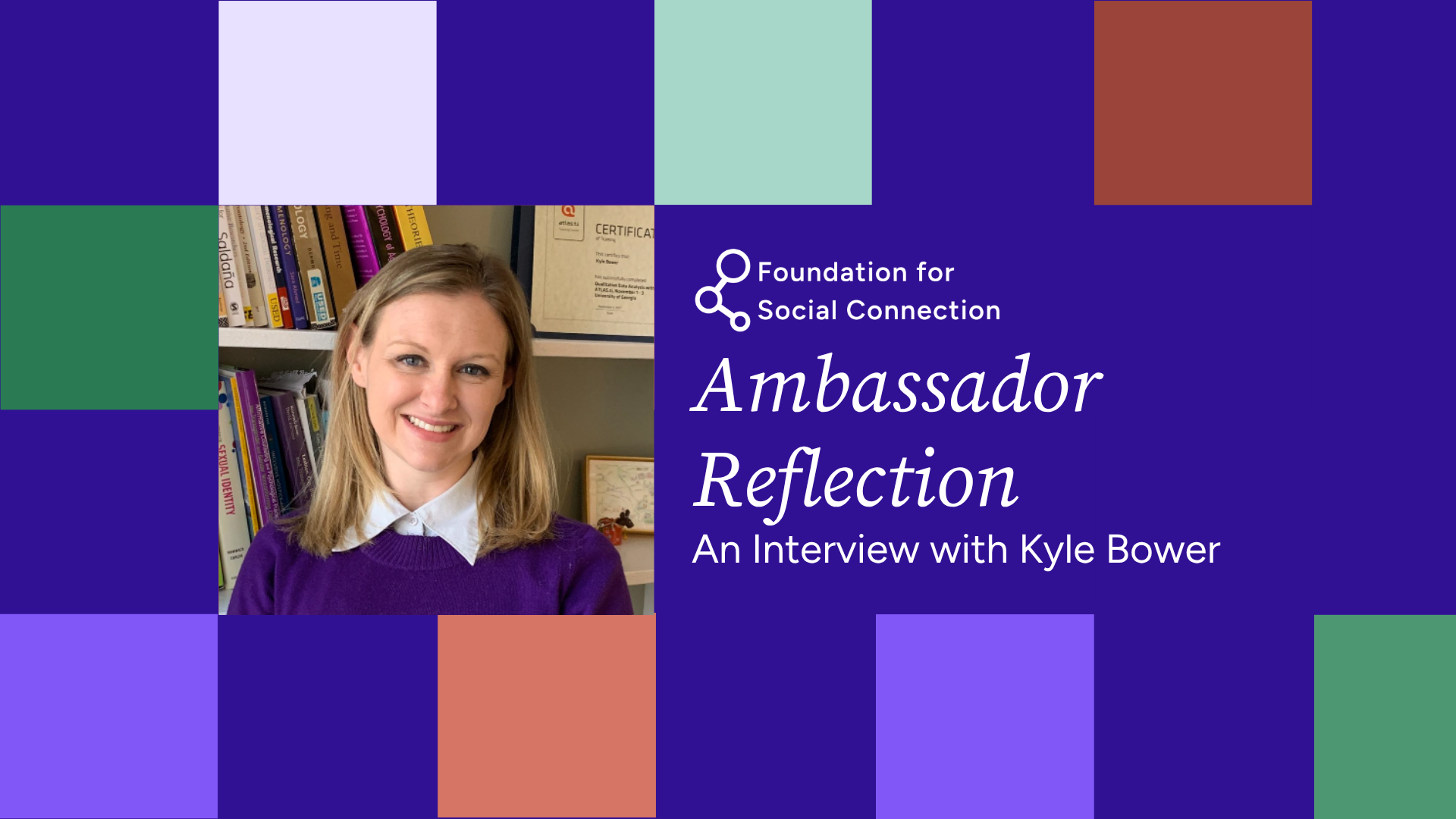
By: Kyle Bower, F4SC Ambassador
My interest in social connection began with a question about how people create meaning across generations. During my dissertation research on generativity among LGBT older adults, I explored how people pass along knowledge, values, experiences, and care to younger generations. I came to understand that generativity is not simply about leaving a legacy. It is also about being seen, having something meaningful to contribute, and feeling connected to a community larger than oneself.
That insight shaped the direction of my career. As a qualitative researcher and professional gerontologist, I have continued to study social connection across the life course, especially among older adults, caregivers, families, and communities. Whether I am evaluating an intergenerational community garden, studying engagement among residents in memory care, or facilitating conversations among aging-service providers, I am reminded that connection is both a deeply personal experience and a public health concern.
One of the most important things I have learned is that social connection cannot be measured only by the number of people someone knows or how often they attend activities. A person can be surrounded by others and still feel disconnected. Meaningful connection requires belonging, trust, reciprocity, and opportunities to contribute. People need to feel that their presence matters, not simply that services are available to them.
This is especially important in work with older adults. Aging is too often framed primarily in terms of decline, dependency, or need. Older adults also hold knowledge, creativity, experience, and a desire to contribute. Programs become more meaningful when they move beyond doing things “for” people and instead create opportunities to build something “with” them.
At the same time, relatively small initiatives can have a meaningful impact. In my evaluation of a community garden in an affordable housing community for older adults, the garden became more than a place to grow food. It created opportunities for conversation, shared purpose, informal support, and relationship-building. In memory care settings, music, movement, and immersive experiences can help people become more socially present through smiling, singing, and interacting with others.
I am encouraged by the momentum building in this field. Social connection is increasingly recognized as essential to physical health, mental well-being, healthy aging, and community resilience. Researchers, practitioners, policymakers, and community leaders are moving beyond documenting the effects of isolation and toward developing practical, cross-sector solutions.
My hope is that social connection will become central to how we design programs, technologies, neighborhoods, and policies. Moving this work forward requires organizations to listen to communities, researchers to translate findings into practical resources, and funders and policymakers to invest in the systems that support relationships.
As an Ambassador for the Foundation for Social Connection, I am grateful to contribute to this growing movement. My work is guided by a simple belief: when people feel seen, valued, and connected, they are better able to support one another and build healthier communities across generations.