
The Roadmap: Reimagining Infrastructure to Improve Social Capital
At the Foundation for Social Connection, we recognize that our relationships contribute to many aspects of our individual and collective well-being, including upward economic mobility. Social capital – the benefits we derive from our relationships – is among the strongest predictors of economic mobility, particularly when it is formed across socioeconomic status.(1)
Social connection is the foundation upon which social capital is built. Through relationships with neighbors, co-workers, and other people in our community, we learn about job opportunities, develop skills to succeed in the labor market, and build the confidence to navigate complex systems.
Developing these relationships with those not in our immediate circle, requires spaces and activities where individuals from diverse networks and socioeconomic backgrounds can meet and interact. Third places – places outside of home and work where people gather informally to connect, converse, and build community – serve as containers for social connection to form and for social capital to thrive.
The Gates Foundation aims to help the U.S. economic system better meet the needs of people experiencing poverty and significantly increase their opportunities to achieve economic success. Their definition of economic mobility is rooted in three pillars: economic success, power and autonomy, and being valued in community. Social capital plays a critical role within each of these pillars.(2) Emerging research on structural social capital reveals the importance of network building, which is highly influenced by investments in infrastructure, community spaces, and neighborhood construction. This dimension of social capital is requisite for making high-quality connections and for social capital to develop among people and across communities. Although class-based segregation and a lack of quality connections affect economic connectedness, systems that prioritize people can play a vital role in an individual’s ability to climb the economic ladder.(3)
This project was born out of a shared commitment between the Foundation for Social Connection and the Gates Foundation to better understand the interrelated concepts of third places, social connection, social capital, and how they contribute to economic mobility. Community visits across the country and interviews with experts from diverse fields helped us develop a framework that encourages local leaders to consider the power of social connection as they make infrastructure investment decisions to advance economic mobility. We believe this roadmap, which includes lessons learned, local examples, and evidence-informed strategies will contribute to building more connected, inclusive, and economically prosperous communities.
A Call for Collective Action
Economic mobility in the United States faces growing barriers as social connection and community ties weaken.
Recent research shows that economic mobility in the United States has generally declined over the past few decades in both urban and rural areas, especially for low-income families who face persistent poverty.(4 5 6 7) One of the strongest predictors of upward income mobility for individuals with low socioeconomic status (SES) is the share of friends they have with high SES, or economic connectedness.
With fewer Americans engaged in civic, religious, and neighborhood associations, opportunities to form “bridging” relationships – ties that expand an individual’s network and access to jobs, mentorship, and resources – have diminished.(8 9) Growing these relationships, which contribute to an individual’s social capital, is especially important in underserved communities, where they can help people move up the economic ladder, narrowing the wealth gap over time.

Relationships across economic lines are among the hardest to build, even more than those across racial or religious differences.(10) Without them, social capital and mobility can remain limited. Civil society itself suffers because democracies require people who have the skills to collaborate and address complex, multifaceted problems together. Social capital can provide individuals with the resources needed to participate in civic life, including access to information, social support, and opportunities for engagement.(11 12). Fostering civic engagement and trust strengthens democratic institutions and overall well-being.(13) There is hope in an approach that focuses on developing a culture of connection and mutuality across neighborhoods, organizations, institutions, and systems. As communities grow more connected, trust and belonging increase, responsibility for one another deepens, and quality of life improves, including health, education, and wealth.(14) Stronger ties also allow communities to mobilize resources and act effectively, creating a cycle of engagement, trust, and efficacy.
Local governments have a key role in supporting this cycle.
- When local leaders invite residents in as partners and invest in “third places” such as libraries, parks, and locally owned gathering spaces, municipalities can create conditions for people and organizations to connect across differences. This approach can generate the trust and networks that open pathways to opportunity.(15 16)
- Physical spaces and models for dialogue that lead to collective action are both critical to this process. The social connection that grows with these interactions is a critical lever for mobility, but must be supported by equitable policies that expand access to resources and opportunities.(17)
- Systems must change to address inequities. A relationship-centered approach rooted in participation and trust between government and residents is essential to building the social infrastructure and civic capacity that underpin economic mobility.
This report is the culmination of a year-long exploration of the connection between social capital, economic mobility, and the importance of investing in neighborhood third places. In particular, we examined the steps local government can take in partnership with residents and local organizations to support investment and measure the impact of interventions that focus on building social connection. This report is available to download as a pdf file in the Resources section.
An Approach Combining Theory and Practice
As evidence is at the root of all our work at F4SC, we began this project with an exploration of the theories of social capital, economic mobility, infrastructure – both physical and social. As we linked these theories to social connection, we included research on social psychology, movement building, and systems change. Conversations with our working group members, subject matter experts, and community members confirmed this direction.
We were guided in particular by two frameworks and two practices. The Water of Systems Change and the Urban Institute’s Upward Mobility Framework provide the link between economic success and social connection. Both frameworks consider how individuals experience belonging, agency, respect, and inclusion, and how those experiences affect power, autonomy, and leadership in a community. Two practices we included are Marshall Ganz’s model for relational community organizing because it develops leadership skills and a pathway to build solidarity and collective power. The practice of Asset-Based Community Development (ABCD) empowers residents by focusing on the strengths, skills, and resources that already exist within a community so they can identify and mobilize their individual and collective assets.
The Water of Systems Change
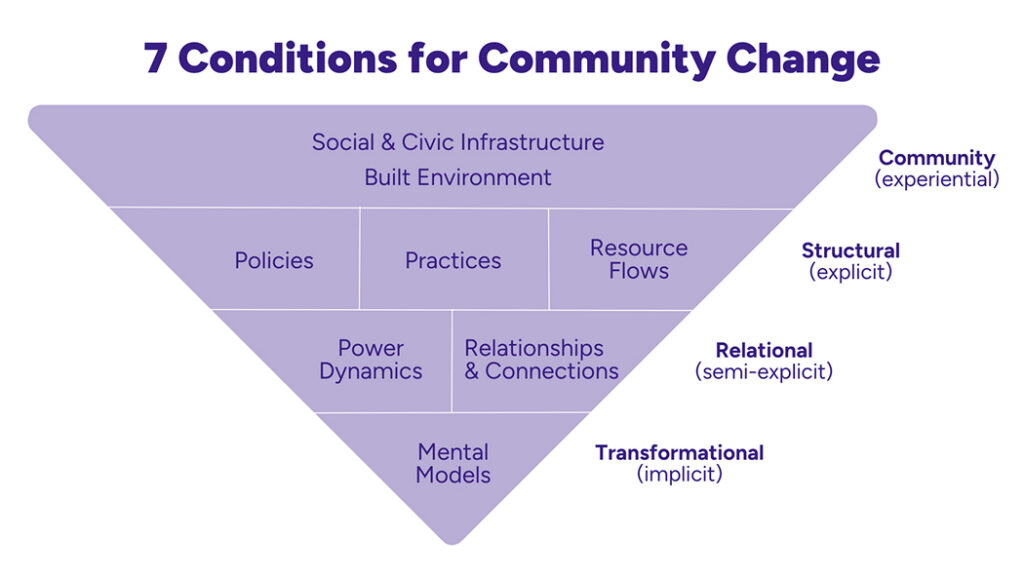
The Water of Systems Change(18) theorizes that if we hope for the outcomes of community change to be more and higher quality social connections that lead to increased social capital, we need to think systematically about how to change a community from being isolated to socially connected. Seven key conditions for systemic change are all connected and have a significant influence on whether communities are isolated or become more socially connected. The pyramid is like an iceberg – there are conditions that are more tangible and explicit and those that are more implicit or invisible. In communities, there are power dynamics within relationships and connections that cannot be ignored. These are conditions that are below the waterline and may seem difficult to engage, but are critical to achieving transformational change. The top layer was not part of the original theory, but was added by F4SC when creating the Action Guide
Urban Institute’s Upward Mobility Framework
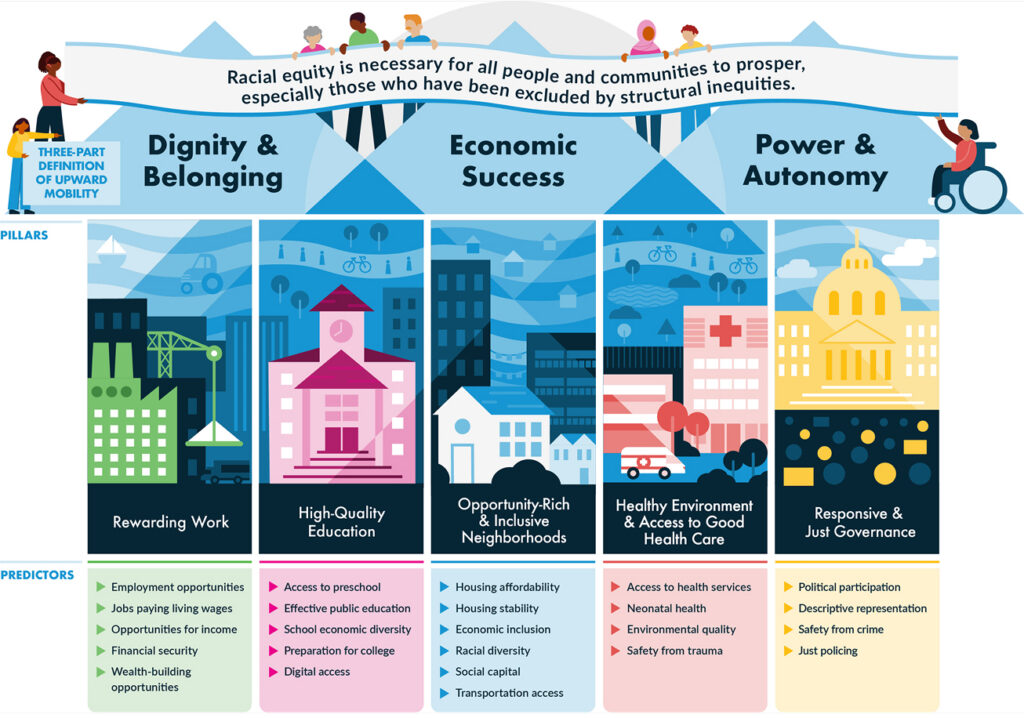
The Urban Institute’s Upward Mobility Framework defines upward mobility not only in terms of economic success, but also through two additional dimensions: power & autonomy, and dignity & belonging, recognizing that people need not just resources, but agency, respect, and social inclusion to thrive. It identifies five pillars of support – rewarding work; high-quality education; opportunity-rich, inclusive neighborhoods; a healthy environment and access to good healthcare; and responsive, just governance. The framework also includes 24 evidence-based predictors (for example, housing stability, preschool access, political participation) and a suite of “Mobility Metrics” so local leaders can measure change not just in income or employment, but in social connection, sense of belonging, health, civic voice – all of which are essential for psychological well-being and sustained upward mobility.
“For any movement to be truly effective, its stakeholders must have strong connections with one another, a personal sense of belonging to the city, and an earnest belief that their well-being is bound up with the well-being of their fellow citizens.”
—AJ Calhoun
Marshall Ganz’s Relational Community Organizing
People → Power → Change
Stronger relationships in communities lead to stronger democracies, but people must have the skills to talk and act together to more effectively address complex, multifaceted problems.(19) Marshall Ganz’s relational community organizing model emphasizes building leadership and collective efficacy through relationships rooted in shared values, trust, and mutual commitment rather than transactional exchanges. By cultivating these connections, communities develop the collective capacity to act on common goals. His framework of public narrative – the “story of self, us, and now” – helps leaders link personal values to shared experiences and urgent challenges, inspiring others to take action.(20) Public narrative provides individuals with the tools for actively increasing their networks (social capital), and the organizing model provides the framework for building collective power for social change.
Asset-Based Community Development (ABCD)
ABCD is a framework pioneered by John McKnight and Jody Kretzmann(21) that emphasizes resident-led community building on existing strengths, skills, and relationships rather than focusing primarily on deficits or needs. By identifying and mobilizing local assets – such as resident talents, neighborhood associations, and informal networks – ABCD fosters collective efficacy and strengthens social capital, particularly bonding and bridging ties. This approach is important for economic mobility because it not only enhances trust and reciprocity among neighbors, but also connects residents to broader networks of opportunity, including jobs, training, and resources. In doing so, ABCD transforms communities from being passive recipients of outside aid into active agents of change, making local development more sustainable and equitable.(22)
Acknowledgements
This report is based on research funded by the Gates Foundation. The findings and conclusions contained within are those of the authors and do not necessarily reflect positions or policies of the Gates Foundation.
F4SC Executive Director
Jillian Racoosin, Foundation for Social Connection
Project Director and Author
Frances Kraft, Foundation for Social Connection
Research, Writing, Community Gatherings, and Creative Direction for Design and Technology
Frances Kraft, Foundation for Social Connection
Prachir Pasricha, Foundation for Social Connection
Sarah Nemetz, Foundation for Social Connection
Community GATHERINGS
Joanne Lee, Healthy Places by Design
Graphic Design
Kathy Chen
Site Development
Zelda Lin, Cause + Effect
Linden Goh, Cause + Effect
Media Inquiries
Shannon Vyvijal, shannon@social-connection.org
PHOTOGRAPHY
San Antonio, Texas
Key Ideas Inc.
Eureka Springs, Arkansas
Onion Studio, Inc.
Hennepin County, Minnesota
Angelic Jewel Photography
Buncombe County, North Carolina
Jeff Kraft
Hartford, Connecticut
Karl Bjorn Wedding Photography
STAFF SUPPORT
Varnika Birla, Foundation for Social Connection
Devanshi Trivedi, Foundation for Social Connection
WORKING GROUP MEMBERS
AJ Calhoun
Alexa Clay
Julia Freeland Fisher
Shamichael Hallman
Julianne Holt-Lunstad
Nikola Ilic
Edna Ishayik
David Jay
Tom Kenyon
Seth Kaplan
Erin K. Peavey
Jillian Racoosin
Celestin Okoroji
Cormac Russell
Cary Simmons
Linda R. Tropp
Danielle Varda
Risa Wilkerson
Local Advisors
Baltimore, Maryland
Sarah Hemminger
San Antonio, Texas
Ann Helmke
Eureka Springs, Arkansas
Jacqueline Wolven
Hennepin County, Minnesota
Chris LaTondresse
Buncombe County, North Carolina
Victoria Reichard, Jenesis Nicolaisen, alexandria monque ravenel, and David Greenson
Hartford, Connecticut
Rick Brush
Chetty, R., Friedman, J. N., Hendren, N., Jones, M. R., & Porter, S. R. (2018).The Opportunity Atlas: Mapping the childhood roots of social mobility. The Quarterly Journal of Economics, 133(3), 1107–1162. https://doi.org/10.1093/qje/qjy007
Turner, M. A., Edelman, P., Poethig, E., Aron, L., Kingsley, G. T., Pettit, K. L. S., & Sard, B. (2018).Charting a course for upward mobility: Policy solutions for reducing poverty and restoring the American Dream. Urban Institute. https://www.urban.org/research/publication/charting-course-upward-mobility
Chetty, R., Dobbie, W. S., Goldman, B., Porter, S. R., & Yang, C. S. (2024).Changing Opportunity: Sociological mechanisms underlying growing class gaps and shrinking race gaps in economic mobility (NBER Working Paper No. 32697). National Bureau of Economic Research. https://doi.org/10.3386/w32697
Chetty, R., Hendren, N., Kline, P., & Saez, E. (2014). Where is the land of opportunity? The geography of intergenerational mobility in the United States.The Quarterly Journal of Economics, 129(4), 1553–1623. https://doi.org/10.1093/qje/qju022
Chetty, R., Dobbie, W. S., Goldman, B., Porter, S. R., & Yang, C. S. (2024). Changing opportunity: Sociological mechanisms underlying growing class gaps and shrinking race gaps in economic mobility.National Bureau of Economic Research. https://doi.org/10.3386/w32697
Ajilore, O., & Willingham, C. Z. (2025). Who is rural America?McKinsey & Company. https://www.mckinsey.com/institute-for-economic-mobility/our-insights/who-is-rural-america
U.S. Department of Agriculture, Economic Research Service. (2023). Rural America at a glance: 2023 edition (Report No. EIB-261). https://doi.org/10.32747/2023.8134362.ers
Putnam, R. D. (2000).Bowling Alone: The Collapse and Revival of American Community. Simon & Schuster.
Chetty, R., Jackson, M. O., Kuchler, T., Stroebel, J., Hendren, N., Fluegge, R. B., … Wernerfelt, N. (2022). Social capital I: Measurement and associations with economic mobility.Nature, 608(7921), 108-121. https://doi.org/10.1038/s41586-022-04996-4
Chetty, R., Jackson, M. O., Kuchler, T., Stroebel, J., Hendren, N., Fluegge, R. B., … Wernerfelt, N. (2022). Social capital I: Measurement and associations with economic mobility.Nature, 608(7921), 108-121. https://doi.org/10.1038/s41586-022-04996-4
Kirk, P., & Shutte, M. A. (2004). Community leadership development.Community Development Journal, 39(3), 234–251. https://doi.org/10.1093/cdj/bsh019
Allen, D. (2004).Talking to strangers: Anxieties of citizenship since Brown v. Board of Education. University of Chicago Press.
Putnam, R. D. (1993).Making democracy work: Civic traditions in modern Italy. Princeton University Press.
Putnam, R. D. (1993).Making democracy work: Civic traditions in modern Italy. Princeton University Press.
Oldenburg, R. (1999).The Great Good Place: Cafés, Coffee Shops, Bookstores, Bars, Hair Salons, and Other Hangouts at the Heart of a Community. Marlowe & Company
Klinenberg, E. (2018).Palaces for the People: How Social Infrastructure Can Help Fight Inequality, Polarization, and the Decline of Civic Life. Crown Publishing Group.
Holt-Lunstad, J., Smith, T. B., & Layton, J. B. (2017).Social relationships and mortality risk: A meta-analytic review. PLOS Medicine, 10(7), e1000316. https://doi.org/10.1371/journal.pmed.1000316
Kania, J., Kramer, M., & Senge, P. (2018).The Water of Systems Change. FSG. https://www.fsg.org/wp-content/uploads/2021/08/The-Water-of-Systems-Change_rc.pdf
Kirk, P., & Shutte, M. A. (2004). Community leadership development.Community Development Journal, 39(3), 234–251. https://doi.org/10.1093/cdj/bsh019
Ganz, M. (2024).People, power, change: Organizing for democratic renewal. Oxford University Press.
Kretzmann, J. P., & McKnight, J. L. (1993).Building communities from the inside out: A path toward finding and mobilizing a community’s assets. Asset-Based Community Development Institute, Institute for Policy Research, Northwestern University.
Russell, C., & McKnight, J. (2022).The connected community: Discovering the health, wealth, and power of neighborhoods. Berrett-Koehler Publishers.
Granovetter, M. S. (1973).The strength of weak ties.American Journal of Sociology, 78(6), 1360-1380.
Chetty, R., Jackson, M. O., Kuchler, T., Stroebel, J., Hendren, N., Fluegge, R. B., … Wernerfelt, N. (2022). Social capital I: Measurement and associations with economic mobility.Nature, 608(7921), 108-121. https://doi.org/10.1038/s41586-022-04996-4
Sampson, R. J. (2012).Great American City: Chicago and the Enduring Neighborhood Effect. University of Chicago Press.
Sharkey, P. (2013).Stuck in Place: Urban Neighborhoods and the End of Progress toward Racial Equality. The University of Chicago Press.
Small, M. L. (2017).Someone to talk to: Why Americans confide in strangers. Oxford University Press.
The Pew Charitable Trusts. (2022, August 31).Partnerships among government and community groups can help boost health equity. https://www.pew.org/en/research-and-analysis/articles/2022/08/31/partnerships-among-government-and-community-groups-can-help-boost-health-equity
Bryson, J. M., Crosby, B. C., & Barberg, B. (2023, April).Public value governance and strategic public management (pp. 92-113) In C. Greve & T. Ysa (Eds.),Handbook on Strategic Public Management. Edward Elgar. https://doi.org/10.4337/9781789907193.00015
Klinenberg, E. (2018).Palaces for the people: How social infrastructure can help fight inequality, polarization, and the decline of civic life. Crown.
Putnam, R. D. (2000).Bowling Alone: The Collapse and Revival of American Community. Simon & Schuster.
Klinenberg, E. (2018).Palaces for the people: How social infrastructure can help fight inequality, polarization, and the decline of civic life. Crown.
Chetty, R., Jackson, M. O., Kuchler, T., Stroebel, J., Hendren, N., Fluegge, R. B., … Wernerfelt, N. (2022). Social capital I: Measurement and associations with economic mobility.Nature, 608(7921), 108-121. https://doi.org/10.1038/s41586-022-04996-4
Small, M. L. (2017).Someone to talk to: Why Americans confide in strangers. Oxford University Press.
Ginwright, S. A. (2022).The four pivots: Reimagining justice, reimagining ourselves. North Atlantic Books.
Ganz, M. (2024).People, power, change: Organizing for democratic renewal. Oxford University Press.
U.S. Department of Health and Human Services. (2021).Protecting youth mental health: The U.S. Surgeon General’s advisory. https://www.hhs.gov/sites/default/files/surgeon-general-youth-mental-health-advisory.pdf
Putnam, R. D. (2000).Bowling Alone: The Collapse and Revival of American Community. Simon & Schuster.
Berkman, L. F. (2000). Social support, social networks, social cohesion and health.Social Work in Health Care, 31(2), 3–14. https://doi.org/10.1300/J010v31n02_02
Sampson, R. J., Raudenbush, S. W., & Earls, F. (1997). Neighborhoods and violent crime: A multilevel study of collective efficacy.Science, 277(5328), 918–924. https://doi.org/10.1126/science.277.5328.918
Chetty, R., Jackson, M. O., Kuchler, T., Stroebel, J., Hendren, N., Fluegge, R. B., … Wernerfelt, N. (2022). Social capital I: Measurement and associations with economic mobility.Nature, 608(7921), 108-121. https://doi.org/10.1038/s41586-022-04996-4
Turner, M. A., Edelman, P., Poethig, E., Aron, L., Kingsley, G. T., Pettit, K. L. S., & Sard, B. (2018).Charting a course for upward mobility: Policy solutions for reducing poverty and restoring the American Dream. Urban Institute. https://www.urban.org/research/publication/charting-course-upward-mobility
Granovetter, M. S. (1973).The strength of weak ties.American Journal of Sociology, 78(6), 1360-1380.
Organisation for Economic Co-operation and Development. (2001).The well-being of nations: The role of human and social capital. OECD Publishing. https://doi.org/10.1787/9789264189515-en
U.S. Department of the Treasury. (2022).Economic mobility. U.S. Department of the Treasury. https://home.treasury.gov/policy-issues/economic-mobility
Organisation for Economic Co-operation and Development. (2018).A broken social elevator? How to promote social mobility. OECD Publishing. https://doi.org/10.1787/9789264301085-en
Turner, M. A., Acs, G., Brown, S., Solari, C. D., & Fudge, K. (2020).Boosting upward mobility: Metrics to inform local action. Urban Institute.
Lee, R. M., & Robbins, S. B. (1995). Measuring belongingness: The Social Connectedness and the Social Assurance scales.Journal of Counseling Psychology, 42(2), 232–241. https://doi.org/10.1037/0022-0167.42.2.232
World Health Organization. (2015).Fostering social connection for global health. https://apps.who.int/gb/ebwha/pdf_files/EB156/B156_CONF18-en.pdf
Holt-Lunstad, J. (2021). Loneliness and social isolation as risk factors: The power of social connection in prevention.American Journal of Lifestyle Medicine, 15(5), 567–573. https://doi.org/10.1177/15598276211009454
Gregory, D. (2018).The collapse and revival of England’s social infrastructure. Local Trust. https://www.localtrust.org.uk/wp-content/uploads/2019/03/local_trust_skittled_out_essay.pdf
Nabatchi, T., & Leighninger, M. (2015).Public participation for 21st century democracy. Jossey-Bass.
Klinenberg, E. (2018).Palaces for the people: How social infrastructure can help fight inequality, polarization, and the decline of civic life. Crown.
Allport, G. W. (1954).The nature of prejudice. Addison-Wesley.
Allen, K. A. (2021). Belonging: A review of conceptual issues, an integrative framework, and implications for mental health and well-being.Australian & New Zealand Journal of Psychiatry, 55(4), 307–314. https://doi.org/10.1177/00048674211033407
Over Zero & American Immigration Council. (2024).The Belonging Barometer: The state of belonging in America (Revised ed.). https://www.americanimmigrationcouncil.org/wp-content/uploads/2025/01/thebelongingbarometer_revisededition_june2024_1.pdf
Das, M. B., Fisiy, C. F., & Kyte, R. (2013).Inclusion matters: The foundation for shared prosperity. The World Bank. https://documents.worldbank.org/curated/en/114561468154469371/Inclusion-matters-the-foundation-for-shared-prosperity
Putnam, R. D. (2000).Bowling Alone: The Collapse and Revival of American Community. Simon & Schuster.
Coleman, J. S. (1988).Social capital in the creation of human capital.American Journal of Sociology, 94(Supplement), S95–S120. https://doi.org/10.1086/228943
Agarwal, B. (2001).Participatory exclusions, community forestry, and gender: An analysis for South Asia and a conceptual framework.World Development, 29(10), 1623–1648. https://doi.org/10.1016/S0305-750X(01)00066-3
National Academies of Sciences, Engineering, and Medicine. (2014).Civic engagement and social cohesion: Measuring progress and assessing the evidence. The National Academies Press. https://doi.org/10.17226/18891
Fung, A., Gilman, H. R., & Schmitt, M. (2022).Strengthening models of civic engagement: Community-informed approaches to inclusive and equitable decision-making. Ash Center for Democratic Governance and Innovation. https://ash.harvard.edu/wp-content/uploads/2022/07/Strengthening_Models_of_Civic_Engagement_2022-07-22_131141.pdf
Urban Institute. (2021).Civic infrastructure: A new concept for building community and advancing equity. https://www.urban.org/sites/default/files/publication/104249/civic-infrastructure-a-new-concept-for-building-community-and-advancing-equity_0.pdf
Over Zero & Center for Inclusion & Belonging at the American Immigration Council. (2024).The Belonging Barometer: The State of Belonging in America (Revised edition). https://www.projectoverzero.org/media-and-publications/belongingbarometer
Strauss C, Lever Taylor B, Gu J, Kuyken W, Baer R, Jones F, Cavanagh K. What is compassion and how can we measure it? A review of definitions and measures. Clin Psychol Rev. 2016 Jul;47:15-27. doi: 10.1016/j.cpr.2016.05.004. Epub 2016 May 26. PMID: 27267346.
What Is Compassion?Greater Good Magazine, Nov. 8, 2020.
Geertz, C. (1973).The interpretation of cultures: Selected essays. Basic Books.
Spade, D. (2020).Mutual aid: Building solidarity during this crisis (and the next). Verso Books.
Gooderham, P. N. (2007). Enhancing knowledge transfer in multinational corporations: A dynamic capabilities driven model.Knowledge Management Research & Practice, 5(1), 34–43. https://doi.org/10.1057/palgrave.kmrp.8500119
Gooderham, P. N. (2007). Enhancing knowledge transfer in multinational corporations: A dynamic capabilities driven model.Knowledge Management Research & Practice, 5(1), 34–43. https://doi.org/10.1057/palgrave.kmrp.8500119
Lamph, G. (2007).Relational environment: Its influence on the therapeutic alliance and mental health nursing practice. Journal of Psychiatric and Mental Health Nursing, 14(1), 46–52. https://doi.org/10.1111/j.1365-2850.2007.01035.x
Scannell, L., & Gifford, R. (2010). Defining place attachment: A tripartite organizing framework.Journal of Environmental Psychology, 30(1), 1–10. https://doi.org/10.1016/j.jenvp.2009.09.006
Jay, D. (2024).Relationality: How moving from transactional to transformational relationships can reshape our lonely world. North Atlantic Books.
Ganz, M. (2024).People, power, change: Organizing for democratic renewal. Oxford University Press.