


About Eureka Springs
Located in the Ozark Mountains, Eureka Springs is a small city in Northwest Arkansas. The city has both deep Christian and LGBTQ histories. Gerald L.K. Smith, who founded the America First Party and Christian Nationalist Party in the 1940s, had the largest statue of Christ in the United States built in Eureka Springs in the 1960s. He also launched the Passion Play in Eureka Springs, which tells the story of Jesus and has become the most attended outdoor drama in the United States. The city is largely homogenous in its racial composition, being 84.63% White as of 2020. The median age in Eureka Springs (50.9) is significantly higher than the state’s (38.4), due to limited economic opportunity and the cost of housing.
Community Context
Strengths
Eureka Springs has a vibrant tourism industry, thanks to its Victorian-era architecture, a strong arts and culture scene, and access to nature. The city is also known as the Bible Belt’s LGBTQ oasis, having become a safe haven for queer and trans people who own local businesses and thrive in the local artist community. In 2014, Eureka Springs became the first city in the state to grant marriage licenses to same-sex couples.
Barriers
With a population of just over 2,000, Eureka Springs has a limited tax base to work with, making it difficult for the local government to take on new or expand existing infrastructure projects, programs, and services. For example, Eureka Springs Transit operates limited hours, particularly during off-peak tourist season. This makes it more difficult for residents to get to and from events and gatherings in and around the community.
Challenges & Questions
How does a community balance tourist and resident interests?
While having a strong tourism industry contributes to Eureka Springs’ local economy, it does not come without its challenges. In pursuit of attracting tourists, the local government can be perceived as prioritizing visitors over the people that call Eureka Springs home. This is reflected in offering reduced public transit hours during off-peak tourist season, having no public pool but many privately operated pools at hotels, and grappling with a housing shortage while vacation homes sit empty. There is a desire for the local government to understand that what is good for the resident is also good for the tourist.
Where do the sober people go?
Eureka Springs has a vibrant bar scene. While this is great for people who consume and enjoy socializing over alcohol, it leaves sober people wondering where they can hang out in the evenings. Community spaces like the library and community center are not open late, leaving little opportunity to gather in a safe, sober way.
Working within siloes (even within a small city)
Local leaders are not always coordinating with or even aware of each other’s programs and services, leading to duplication of efforts and/or missed opportunities to maximize what is available to the community. This can be particularly unfortunate in a community with limited resources as it is, given its size. For example, while it does have some partnerships with local stakeholders, Eureka Springs’ school system is not well-integrated with the rest of the community. The Eureka Springs Community Center does not operate under the City, instead acting as an independent non-profit. There are opportunities for coordination, collaboration, and integration that could create a stronger enabling environment for social connection to form and social capital to thrive.
Connecting comes with a price tag
Whether it be memberships for clubs/associations or fees for gathering spaces, the ingredients for connection are often costly, making it difficult for residents of all socioeconomic statuses to be able to build relationships. This is exacerbated by limited hours for public transit and public spaces, both of which can make access to connection inequitable.
How do you find out about opportunities and resources?
Community members expressed a need to be able to easily access sources of information to help meet basic needs like housing and employment. Ideas included a centralized job listing and a housing vacancy portal.
Promising Initiatives
Eureka Springs Carnegie Library
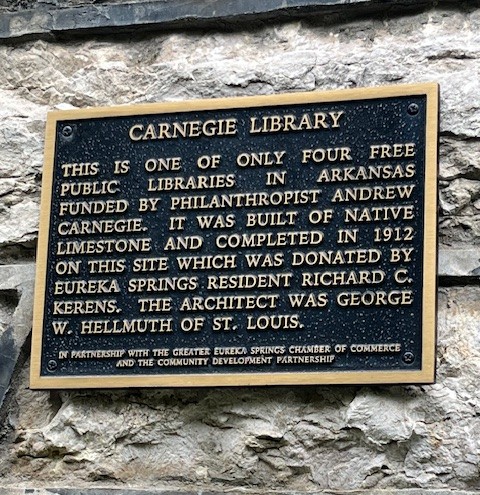
For more than 100 years, the local library – one of four in Arkansas built with funding from 19th-century industrialist and philanthropist Andrew Carnegie – has sought to meet the community’s needs for knowledge, creativity, and connection. Its many offerings include Spanish classes, a seed library for gardening, and a weekly book club. The meeting room used by the book club also serves as a space for civic and social groups in the community to gather.
Through its partnerships with other community organizations, the Eureka Springs Carnegie Library demonstrates the power of collaboration. For example, the library now offers a small collection of books and a dropbox at the Eureka Springs Community Center (located in a different part of the city). The library also makes an effort to coordinate the timing of its programming with other organizations to avoid scheduling conflicts and allow residents enough time to get between different events in the community.
The library has its finger on the pulse when it comes to residents’ wants and needs and adjusts its collection and programming accordingly – for example, by expanding its manga collection to meet growing demand. This responsiveness to community voice pays off in times of need. For example, the library needed to raise $150,000 to install an elevator and make its building accessible. In just a few months, the community had rallied together to cover the costs.
The library also demonstrates how communities can be innovative in how they activate public spaces without having to make big capital expenditures. When the church next to the library became available for sale, the library saw it as an opportunity to expand how it serves the community. The church is now used for movie nights, pop-up animal events, and performances.

Echo Village
With 19 homes and counting, ECHO Village is a housing development for low-income individuals experiencing challenging life circumstances, including domestic abuse, returning to the community after incarceration, and family rejection. Notably, Echo Village is a partnership between ECHO – Eureka Christian Health Outreach – and Safe to Be, a nonprofit supporting romantic & gender diverse people who need a safe place to live. The project is a powerful example of how community members with seemingly conflicting ideologies can work together to build a more connected community.
This initiative also goes much beyond providing shelter. Recognizing the importance of connection and social support when navigating periods of transition, ECHO Village includes a wide variety of shared spaces where residents can come together to support each other. These include a chicken coop, community garden, and Hospitality House, an event/gathering space in the center of the property. One success story is a woman who came to ECHO Village in search of housing during a difficult time. Following her time there, she went on to find a job and build her own home.

Eureka Springs Community Center
Eureka Springs Community Center was developed at the abandoned Eureka Springs high school campus, serving as yet another example of how – even in a small city with relatively little spaces – local leaders can be resourceful in meeting the community’s needs. Through a fitness center, gymnasium, event spaces, and more, the community center brings residents of all ages together through sport and recreation.
The community center also recognizes the importance of natural third spaces and seeks to take advantage of its proximity to Eureka Springs’ extensive trail system. This will be done through providing parking, an area to hold hiking and mountain bikes, and additional green space on its campus. The community center’s campus is also home to the year-round Eureka Springs Farmers Market. With plans for a splash pad, open-air pavilion, and more, the Eureka Springs Community Center continues to serve as a multifunctional third place for all.
It does so as an independent nonprofit, with no funding from the City. The organization’s revenue streams collectively demonstrate the power of cross-sectoral collaboration to make a vision a reality. A building on the community center’s campus has been transformed into the Eureka Springs Business Center. The business center is used by a variety of local businesses, whose rent is used to cover the nonprofit’s operating costs. Between its rental income, corporate sponsors, and donors, the community center is a financially sustainable third space. Learn more about the Eureka Springs Community Center.
Main Street Eureka Springs
An accredited Main Street program through Main Street America and Main Street Arkansas, Main Street Eureka Springs works towards building a vibrant Downtown District in the city. From offering its space as a coworking space every Wednesday on a sliding scale to bringing together four groups (women/femme entrepreneurs & leaders, LGBTQ+ entrepreneurs & allies, healing arts entrepreneurs, and creative entrepreneurs) on a monthly basis to foster civic engagement and build belonging, all community members can connect with each other through Main Street Eureka Springs one way or another. The organization also facilitates the Eureka Springs Nonprofit Alliance, a monthly gathering for directors of 501(c)(3) nonprofit organizations committed to enhancing the quality of life in Eureka Springs. This gathering supports community collaboration and partnerships. Building off of the work done through this project, Main Streets Eureka Springs will offer a community organizing cohort in the beginning of 2026.
Gatherings
Our visit to Eureka Springs was coordinated by our Local Advisor, Jackie Wolven, who leads Main Street Eureka Springs. She works to bring in additional resources through her work with Citizen University and Weave: The Social Fabric Project. She is also a certified facilitator.
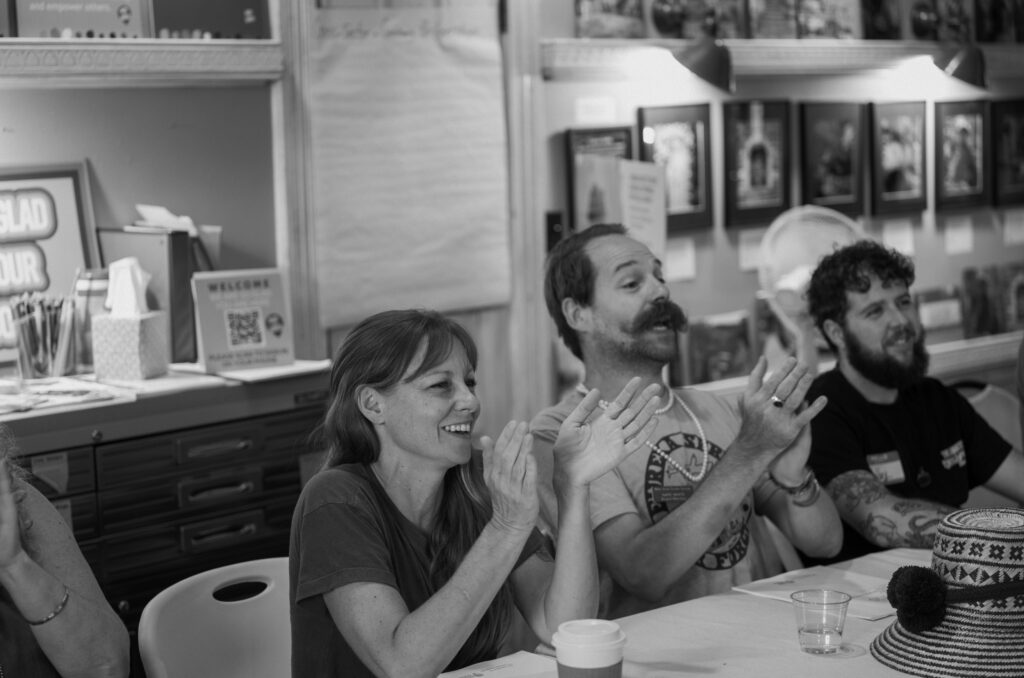
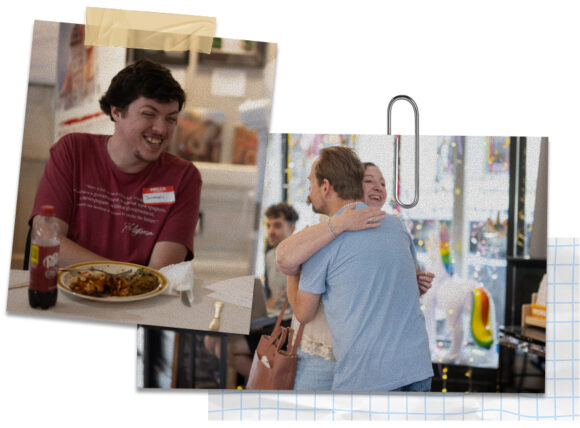
Jackie organized two gatherings: A dinner on a Tuesday evening welcomed approximately 20 residents to Main Street Eureka Springs to get to know each other, provide input on the social capital framework, and discuss their vision for Eureka Springs. Many attendees were connected to the resources provided by various community non-profits, but unaware of their ability to participate in local government (e.g., attending City Council meetings). Together, they reflected on their community’s strengths, challenges, and opportunities.
The following afternoon, more than 20 local leaders, including the Mayor, elected officials, and leaders of third places and non-profits, gathered for lunch at Main Street Eureka Springs. The gathering served as an opportunity to break down silos, provide input on the social capital framework, and discuss a vision for Eureka Springs. Attendees remarked that this was the first time a meeting across community groups that encouraged relationships and reflection had been organized. The leaders were eager to hear resident input from the previous day’s gathering and receptive to meeting with community members to continue the conversation.
Both gatherings served as catalysts for collaboration. Community members are preparing to launch a grassroots community organizing pilot program in 2026, while local leaders are identifying cross-sectoral projects to seek support from the Northwest Arkansas Economic Development District.
A dense network between local leaders comes in handy when rallying residents because they have a strong sense of connectedness to the places and the people who lead them. These benefits emphasize the value of focusing on a local or hyper-local level.

Findings
Community members have ideas for how to make their community better – they just need (accessible) opportunities to share them.
For many attendees, the community gathering was the first time they had been asked questions like: What do you like about Eureka Springs? What do you want to see change? What policies do you want to see enacted? Providing a time and space for exploring these topics tapped into a wide range of suggestions for how to make Eureka Springs better. Everything from creating a downtown parking pass to making it easier to organize yard sales came up in conversations and was met with great enthusiasm from the rest of the group. Being centrally located, providing food, and offering $100 gift cards all helped encourage attendance and foster engagement at the gathering. Residents spoke directly to this need to address barriers to engagement when it comes to the local government, noting the value of providing childcare and virtual opportunities.
There is value in starting (and even staying) small.
It became clear that organizations’ ability to coordinate programs and services is an outcome of a dense network of relationships between local leaders, which – in turn – is made easier by Eureka Springs’ size. This also comes in handy when rallying residents behind fundraising needs. When the elevator in the library needed major repairs and when ECHO Village wanted to build a Hospitality House, a strong sense of connectedness to these places and the people who lead them helped these organizations quickly meet these needs. These benefits emphasize the value of focusing on a local or hyper-local level, even in larger communities at the block or neighborhood level.
With strong relationships comes accountability.
Having a dense network of relationships can mean having a tight feedback loop between local leaders and residents, allowing the former to be efficiently and effectively responsive to the wants and needs of the latter. However, being able to respond to community wants and needs comes with being demanded to respond. This is particularly the case when local leaders collect data or administer surveys, given that residents are able to point to the information that was collected and hold local leaders accountable to following up on it. Failing to do so can erode trust and increase apathy, creating a gap between what local leaders do and what residents want/need.
