
About Buncombe County
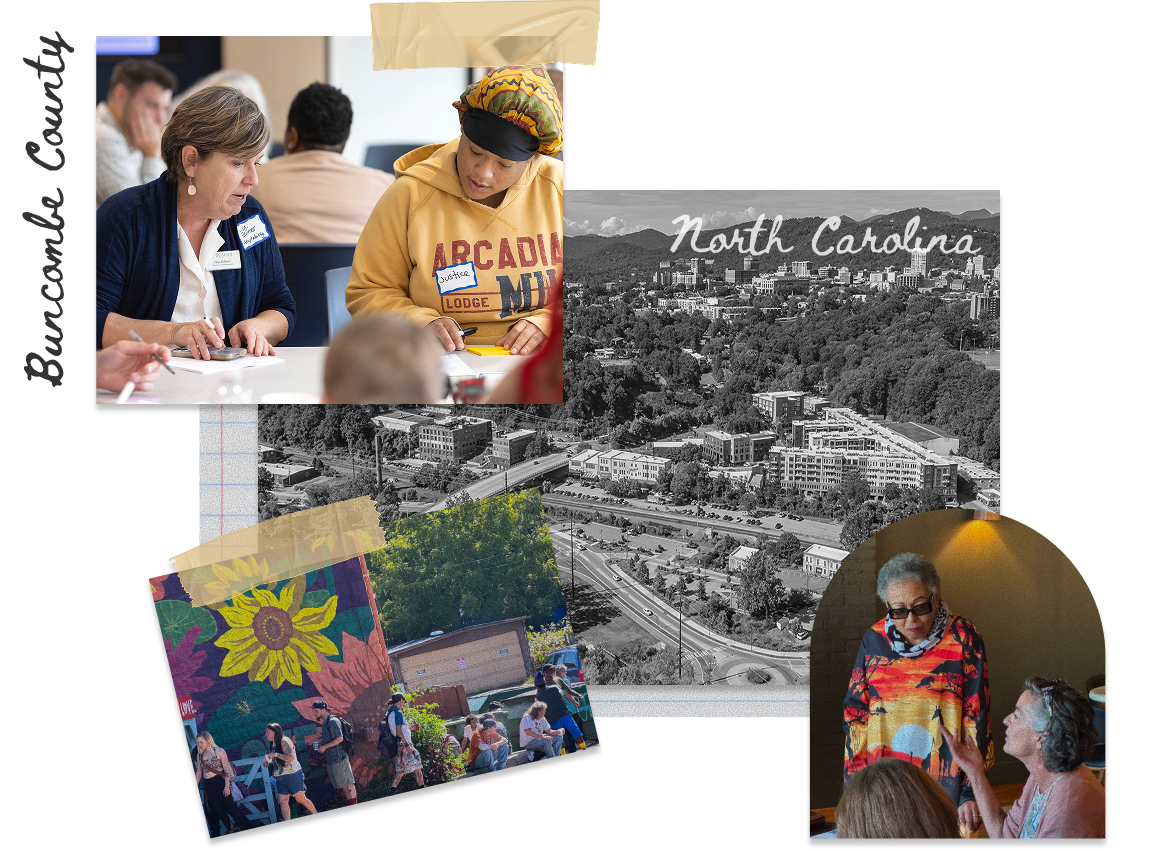
Buncombe County, North Carolina, is located in the Blue Ridge Mountains and anchored by its largest city, Asheville, known for its arts culture, outdoor recreation, and growing tech and healthcare sectors. The county has a population of roughly 275,000, with a racial composition of about 85% White, 7% Black or African American, 7% Hispanic or Latino, and 1% Asian. The median age is around 43, reflecting an older demographic compared to the national average. Urban Asheville is more densely populated and economically diverse, attracting tourism, higher education, and creative industries, while the county’s rural areas are more agricultural and face challenges related to transportation, and broadband access. Both struggle with housing affordability.
Community Context
Strengths
Buncombe County has a robust tourism economy (generating nearly $3 billion annually and supporting about one in seven local jobs) alongside a vibrant creative and cultural sector that drives innovation and attracts residents and visitors alike. The county benefits from proactive economic development efforts through initiatives like AVL 5×5, a high quality of life rooted in its scenic natural environment, and a strong sense of place that fuels entrepreneurship and population growth. Together, these assets make Buncombe County a thriving hub for culture, economic opportunity, and sustainable regional development.
Barriers
Patterns of racial and economic segregation persist, with many Black and Hispanic residents concentrated in lower-income urban neighborhoods, while predominantly white populations are more common in rural and suburban parts of the county. This urban–rural divide reinforces disparities in income, opportunity, and social connectedness across the region. In addition, the area continues to recover from the devastation of Hurricane Helene in 2024.
Challenges & Questions
There is a measurement and data gap
Current systems rely heavily on quantitative indicators like census data, service usage, and service enrollment, but rarely capture the qualitative dimensions of connection – how people build trust, collaborate, or access opportunity through relationships. This creates a measurement gap. Can measurement assess how services connect people or foster economic mobility? Are we asking the right questions? How can we connect and share data across agencies to track relational outcomes more effectively?
Resource mapping could improve utilization
Despite an abundance of physical and institutional assets including parks, community schools, libraries, and recreation centers, these spaces are often underused, siloed, or overshadowed by new initiatives that capture attention and funding. Government leaders emphasized the importance of recognizing and optimizing what already exists, such as using a neighborhood park year-round or transforming libraries into resilience hubs. Yet, the absence of a unified community or county-wide resource directory makes it difficult to see where assets overlap or could be better leveraged for connection.
Persistent barriers affect cross-sector collaboration
While many strong community organizations and coalitions exist, competition for funding and recognition limits partnership and information sharing. Faith-based institutions, technology companies, and academic partners remain under-engaged despite their potential influence, while smaller nonprofits struggle with capacity constraints. How can the community design incentives for collaboration, develop shared accountability frameworks, and ensure ongoing learning across organizations?
Community voice and accountability are missing
Officials acknowledged that while engagement activities such as community meetings, surveys, and storytelling events are robust, many residents experience participation fatigue and feel unheard after providing input. Policies like open meeting laws, though well-intentioned, can inadvertently create barriers to participation for working families or marginalized residents. How can government move from consultation to co-creation and how can they establish continuous feedback loops that demonstrate responsiveness and accountability to community voice?
Can systems be reshaped to be inclusive?
Although community collaboration was strong during storm recovery, gaps in transportation and mobility continue to isolate residents, particularly in rural and low-income areas. Participants noted that regional parks tend to be more diverse and inclusive than smaller neighborhood parks, highlighting how design and scale shape opportunities for social mixing. How can planning, land use, and regulatory systems be leveraged to encourage more inclusive third places and connected neighborhoods in both urban and rural contexts? At the community gathering, participants asked a crucial question: “Who is social infrastructure working for?”

Promising Initiatives

Pack Memorial Library
Pack Memorial Library, the main branch of the library system located in downtown Asheville, serves as a vital hub for community learning, resilience, and connection. Beyond providing access to books and technology, the library offers after-school tutoring and educational support programs that strengthen partnerships with local schools and help close learning gaps for students. During Hurricane Helene, the library played a critical role as a resilience and recovery hub, providing shelter, WiFi, charging stations, and information access to residents in need. Its Hell or High Water storytelling project further demonstrates the library’s commitment to community voice, creating a space for residents to share experiences of loss, recovery, and hope, and to strengthen the bonds that sustain Asheville through crisis and renewal.

UMOJA
Umoja Health, Wellness, and Justice Collective is a Black-led organization dedicated to advancing racial equity, community health, and economic empowerment. Founded to confront systemic injustices and amplify Black voices, Umoja operates at the intersection of advocacy, wellness, and cultural preservation. The organization partners with local groups to promote public health equity, affordable housing, and leadership development within historically marginalized neighborhoods. During the recovery from Hurricane Helene, Umoja played a vital role in coordinating relief efforts and ensuring that resources reached Black and low-income residents often overlooked by formal systems. Through community events, healing circles, and youth engagement programs, Umoja strengthens civic participation while reclaiming third places for belonging, dialogue, and collective healing across Asheville’s diverse communities.

The People’s Place
The People’s Place serves as a grassroots community hub dedicated to advancing equity, connection, and local empowerment through accessible programming and collective organizing. Rooted in principles of inclusion and social justice, it provides a welcoming space for residents to gather, share stories, and mobilize around issues such as housing justice, racial equity, and community healing. The space regularly hosts social connection gatherings and educational workshops while partnering with local organizations to build networks of care across the city. During the aftermath of Hurricane Helene, The People’s Place functioned as both a relief site and a storytelling venue, offering residents a place to process trauma and strengthen solidarity. By fostering dialogue and action at the neighborhood level, The People’s Place exemplifies how social infrastructure rooted in belonging can become a driver of civic resilience and transformation.

Seek Healing
SeekHealing is a nonprofit organization rooted in the belief that social health – human connection and genuine relationships – is key to healing trauma, addiction, and isolation. Founded in 2018, SeekHealing has partnered with a range of community organizations, mental-health agencies, and recovery networks to deliver listening trainings, connection practice circles, and other relational-based supports free of charge. The organization uses neutral, welcoming gathering points such as its Asheville clubhouse on South French Broad Avenue to host weekly open-doors, substance-free social events, peer-led circles, and skill-building workshops. Through its emphasis on community voice, SeekHealing invites participants to show up as themselves, share their stories in safe settings, and build peer-to-peer networks of care.

12 Baskets Cafe
12 Baskets Café is a community-driven initiative founded by the nonprofit Asheville Poverty Initiative that seeks to reduce food waste and hunger while fostering dignity, connection, and belonging. The café rescues surplus food from local restaurants, caterers, and grocers, redistributing it in a welcoming third space where all residents are invited to share free meals together – no questions asked, no hierarchy between those serving and those eating. Located in the West Asheville neighborhood, 12 Baskets functions as both a food justice hub and a social bridge, encouraging authentic dialogue and mutual care across socioeconomic and racial divides. During the aftermath of Hurricane Helene, the café partnered with faith organizations and grassroots volunteers to provide meals and gathering space for displaced residents, strengthening its role as a cornerstone of relational resilience. Through its inclusive model, 12 Baskets Café demonstrates how hospitality, shared meals, and repurposed abundance can build social capital and nourish community wellbeing.

YMI Cultural Center
The YMI Cultural Center, one of the oldest African American cultural institutions in the United States, was originally built in 1893 for Black craftsmen working on the Biltmore Estate. Today, Young Men’s Institute (YMI) serves as a vital third place and cultural anchor for Asheville’s historically Black community, offering arts programming, civic engagement forums, youth development initiatives, and partnerships that amplify community voice. The center hosts exhibitions, performances, and dialogues focused on racial equity, social justice, and heritage preservation while providing space for local entrepreneurs and organizations to collaborate. In recent years, YMI has partnered with groups such as the Asheville City Schools Foundation and the City’s Office of Equity and Inclusion to advance community-based education, mentorship, and restorative justice efforts. During and after Hurricane Helene, YMI played a key role in supporting local recovery and organizing, reinforcing its legacy as a place where history, healing, and collective action intersect to strengthen community connection and resilience.
Gatherings
Our visit to Buncombe County was facilitated by Victoria Reichard, the Behavioral Health Manager for Buncombe County Government, and Jenesis Nicolaisen, the co-founder and Executive Director of Seek Healing. We were joined for our community gathering by The People’s Place leaders alexandria monque ravenel and David Greenson, who co-led the conversation. Government leaders met over lunch to provide their feedback on the framework. Many also joined residents and organization leaders for an evening gathering at Blank Space. The event drew nearly 90 attendees. The evening began as other sessions, with our storytelling activity and review of the framework; however, during the share-out portion, several Black residents asked for an honest discussion of racial disparities and the exhaustion and anger that occur when community conversation doesn’t lead to change. We chose to pivot to allow for a free-flowing conversation that was guided by alexandria and David, who offered to host next gatherings and to bring residents together for planned action.

Individual and collective goals are often intertwined and simultaneously addressed through connection.

Findings
Inclusion is a first step toward empowerment.
Government leaders feel a strong and unified commitment to social connection as a driver of civic and economic resilience, expressing that relationships and networks are core infrastructure essential for addressing inequality, building trust, and supporting upward mobility. Events like Asheville’s Community Nights and Coffee with the Councilwoman can help bring community voice into governing. They also pointed to ongoing efforts such as the reparations process, Grassroots Alliances, and storytelling venues like Hell or High Water; however, they acknowledged that empowerment must go beyond inclusion. It requires leadership pipelines, shared data transparency, and consistent follow-up to sustain relationships between government and the public.
Partnerships during a crisis response can serve as a model, but the work is not done.
Officials point to the coordinated recovery following Hurricane Helene as a model of successful intergovernmental teamwork that could be extended to social connection and economic mobility strategies. Participants envisioned creating similar mechanisms (shared goals, transparent communication channels, and community conveners) to align local government, nonprofits, and the private sector.
Residents also noted that after Hurricane Helene, the community saw a surge in collaboration, as reflected in the Swannanoa Grassroots Alliance, which quickly convened regular meetings across sectors to coordinate relief and recovery. This period demonstrated the community’s ability to mobilize and tell positive stories of resilience, yet participants cautioned that some groups – especially Black and Latinx residents and people experiencing homelessness – were left behind and are still struggling. Out-of-town organizations often dominated recovery efforts without deeply engaging local voices. Residents identified small grassroots organizations, community gardens, and public schools as key institutions that anchor connection and provide access to services. These places often serve as both learning environments and gathering spaces, particularly for residents who lack other access points. However, some of these essential hubs have been defunded or lost over time. Residents noted that cross-department collaboration has led to some local successes, such as Emergency Services’ Community Paramedics program and partnerships between schools and tech organizations to expand skills training. Yet, major challenges remain in aligning policy with equity goals. Law enforcement’s handling of the unhoused population revealed gaps in coordination and compassion. Funding inequities persist, with money not flowing to communities most in need, and residents cited frustration with state and federal barriers such as the Department of Justice challenging a local reparations effort that had been approved at the local level.
Mapping assets and resources can support alignment and equity.
There was also a shared emphasis on asset optimization rather than constant expansion. Government leaders discussed a “resource mapping” approach to identify and repurpose existing community infrastructure. For example, libraries can serve as resilience hubs, schools as community centers, and parks as year-round social gathering places that connect residents across backgrounds. They also noted the importance of policy alignment and equitable design. Policies that open access, such as allowing nonprofits to use libraries at no cost, exemplify how regulatory flexibility can expand civic infrastructure. Leaders stressed embedding connection requirements and social capital metrics into strategic plans and budget processes to ensure accountability. Across discussions, there was a shared belief that connection and belonging are not byproducts of good policy. They are the foundation of resilient, equitable governance.
Difficult conversations about racism and poverty take time, commitment, and resilience.
Residents identified systemic racism and intentional poverty as root causes that must be addressed for lasting change. Too often, efforts treat symptoms rather than causes, resulting in fragmented outcomes. Some expressed fatigue with conversations that lead to little visible change. They observed that youth are largely absent from these spaces, which undermines long-term impact.
Real progress requires connection across lines of income, race, and experience, grounded in accountability and shared power. Residents stressed that meaningful implementation begins at the micro level around tables where people talk, share phone numbers, and commit to follow-up. Social connection takes investment, and without funding for housing, mental health, and basic needs, measurement alone is hollow. Healing cannot occur without honesty and the willingness to confront uncomfortable truths, including the lasting harms of gentrification and exclusion. Change begins through ongoing activity and relationships, not one-off meetings. Healing starts when people feel seen, heard, and valued for their stories rather than treated as data points.
