
Roadmap and Key Findings
A call to action for local government, in partnership with community members and organizations, to think and act differently as part of a movement to build social connection.

With the framework as a guide, we traveled to six communities, where we conducted more than 50 interviews with local leaders and residents, visited more than 40 third places, and hosted nearly a dozen gatherings. Leading up to the gatherings in each community, local leaders and other community members were asked to share their perspectives on a wide range of topics and the extent to which these topics were prioritized by local government, including social connection, social capital, social infrastructure, and economic mobility.
Key findings worth noting include:
- Nearly half of both local leaders and community members strongly agreed that they were familiar with the concept of social capital and its role in community well-being.
- Nearly 66% of local leaders and 75% of community members strongly agreed that social infrastructure should receive as much or more investment as physical infrastructure.
- And more than 66% of local leaders who responded strongly agreed that investing in social connection can help reduce inequality and promote upward mobility in their communities.
- These sentiments were not fully reflected in how communities identify priorities and allocate funding. Only 28% of government respondents strongly agree that promoting social capital is an explicit goal in their community’s local strategic plans or comprehensive community efforts.
- Only 16% strongly agree that economic mobility is a key objective of their city’s planning, zoning, or investment strategies.
- Only 8% strongly agree that there are adequate line items in their budget that promote building social capital (i.e., investment in public spaces). In addition to providing feedback on the framework, communities shared about the initiatives that are having a positive impact on their communities level of social connection.
In addition to providing feedback on the framework, communities shared about the initiatives that are having a positive impact on their communities level of social connection. The roadmap is informed by both our framework and our work in communities, and illustrates how these theories can be applied in practice. For examples, please refer to the Promising Strategies described in each Community Profile. The roadmap identifies how local government, in partnership with communities, can invest in the infrastructure in third places and the activities that encourage cross-class interaction to build social capital and promote economic mobility.
Rather than a step-by-step program to be implemented, the roadmap is a call to action for local government, in partnership with community members and organizations, to think and act differently as part of a movement to build social connection. This requires shifting mindsets and systems toward creating ongoing opportunities to intentionally connect community members, especially in under-resourced neighborhoods. With wider networks, increased civic participation, and stronger feelings of belonging and agency, residents have greater opportunities to thrive in flourishing neighborhoods. F4SC’s Action Guide for Building Socially Connected Communities can help facilitate how your community adopts and adapts the roadmap.
The Roadmap: The graphic below is a guide for how local government, in partnership with residents and organizations, can promote a social connection movement and invest in third places and the activities that encourage cross-class interaction to build social capital and promote economic mobility. Refer to the individual Community Profiles for related Promising Strategies we observed in each location and also the Emerging Interventions link in the Resources section of this site.
Identify People, Places, and Programs
A first step, whether you are a government leader, a nonprofit staff member, a librarian, or a community member, is to begin identifying others who are interested in bringing people together to build connection. Use the Action Guide’s partnership mapping exercise to help identify these stakeholders. Multiple, ongoing 30-minute one-on-one conversations using a simple format builds trust between people that leads to bigger gatherings. As small groups begin to meet, they should always consider other individuals, organizations and places to invite into the planning. At all times, groups should ask themselves who is not at the table, with a specific eye to populations and neighborhoods that have been marginalized or underserved. An activity that supports this exercise is asset mapping, which is a tool of Asset-Based Community Development. Led by community members, asset mapping moves power into the hands of residents and associations in a community so that they can imagine and take the action that they want to take in their community.
Invest in Opportunities for Intentional Connection
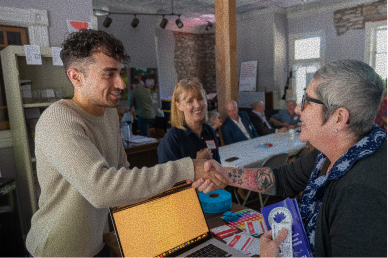
We are all shaped by our identities and experiences. Approaching a challenge as large as increasing economic mobility requires a desire by individuals to understand the lived experience of others who may be different and to then work together for equitable opportunities. This mindset is especially important when leaders and residents work together because power dynamics can make it difficult to build trust. Ongoing interaction helps build trust and connect people across shared values. It is also important for individuals to look inward to develop clarity and self awareness and embrace a “humble curiosity and the possibility of belonging.”(35) Public Narrative storytelling is an ideal model to lead people through telling their own story, community identity, and to move together toward collective action.(36) Accessible third places like libraries, community centers, cafes, parks, block parties, and other locations where neighborhood residents meet all present opportunities for informal gatherings to enjoy music and food, and also more structured interaction for community building. Unrestricted microgrants to local residents go a long way toward supporting the builders of social connection and connective capacity. When paired with local evaluation, communities can learn to what extent people take advantage of these opportunities, feel greater connectedness to others, and greater belonging in their community.

Analyze Policies, Processes, and Goals
When mapping the places where people meet and connect in neighborhoods, be sure to note their location, accessibility (including transportation, building layout, and costs like parking fees), hours of operation, language translation, and how inclusive and inviting they are for diverse cultures. All community members should feel a sense of belonging in these spaces. As you look closer, begin to question how resources are allocated across the community from government sources and organizations. A good exercise for cross-sector groups, organizations, third-place leaders, and residents is to have continued open dialogue about how policies, processes, and spending may affect populations differently and then create a strategy and goals for addressing inequities together. The Action Guide for Building Socially Connected Communities includes guidance on organizing a Community Listening Session to facilitate this dialogue. Invite leaders who hold formal power (elected officials, school superintendents, law enforcement) to join if they can participate as residents. They can bring facts, data, and partnership to the work. At all times, residents who are most impacted by inequitable systems should lead.

Embed Dialogue, Organizing, Civic Literacy, and Job Readiness in Third Places
No individual or single group can build a movement of social connection – especially one that is powerful enough to change neighborhoods and impact the economic success of residents. Third places, when they serve as social meeting spaces and civic hubs, provide opportunities to activate and create strategies for change. Whether a group plans to create a community garden or change school policies, they must be able to identify current policies, goals, tactics, tasks, and the people who will lead. Relational organizing and ABCD are the tools of change because they intentionally build leadership, power, and agency. If residents are invited to learn these skills as part of the ongoing programs available at places like libraries, they are better equipped to take part in the democratic process and participate in the change that is needed in communities.

Align on Community Measures
When looking at economic and social connection indicators, measures by county or ZIP code are useful and available from organizations like the Opportunity Atlas and F4SC’s Data Dashboard. The data accessed, however, may be skewed because of different neighborhoods within these larger geographies. In addition, our framework suggests collecting primary data in neighborhoods to determine how residents experience connection, which can lead to building networks and social capital. Do they trust the people around them and feel a sense of belonging? Do they feel local government is listening, and do they have the tools they need to participate fully in the democratic process? Our Measurement section provides sample surveys that can be used with residents and to assess third places.
Promote Social Connection as a Movement
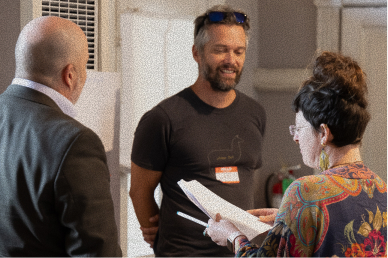
For connection to sustainably thrive in our communities, it cannot be limited to large, one-off events. There is power in small, everyday interactions with our neighbors, making social connection something that is accessible to all. Third places that foster these interactions help create the conditions for storytelling, partnership-building, and collective care. In this way, social connection shifts from being a “nice-to-have” for a select few to a “must-have” for all. Social infrastructure becomes the foundation where connection can take root and grow, cultivating a culture in which every person’s future and well-being matter. The Action Guide includes guidance on building public support for social connection.

Key Findings
Culture matters.
When asked about their communities’ strengths and challenges in fostering social connection, a culture of connection and a culture of individualism were the second most commonly identified strength and challenge, respectively. Similarly, local leaders also identified culture as one of their jurisdiction’s greatest strengths in fostering social connection and building social capital. This aligns with the Office of the Surgeon General’s pillar of creating a culture of connection in the Advisory on the Healing Effects of Social Connection and Community.(37)
Values and beliefs are not fully reflected in policies, practices, and priorities.
Nearly half of both local leaders and community members who completed the survey strongly agreed that they were familiar with the concept of social capital and its role in community well-being. Even more – nearly 66% of local leaders and 75% of community members – strongly agreed that social infrastructure should receive as much or more investment as physical infrastructure. And over 66% of local leaders who responded strongly agreed that investing in social connection can help reduce inequality and promote upward mobility in their communities.
However, these sentiments were not fully reflected in how communities identify priorities and allocate funding. Only 28% of government respondents strongly agree that promoting social capital is an explicit goal in their community’s local strategic plans or comprehensive community efforts; only 16% strongly agree that economic mobility is a key objective of their city’s planning, zoning, or investment strategies; and only 8% strongly agree that there are adequate line items in their budget that promote building social capital (i.e., investment in public spaces). Collectively, this suggests a dissonance between what local leaders and community members value/believe and the extent to which these values and beliefs are realized by local government. As one respondent put it, “[There is a] lack of strategic prioritization of social connections across [the] city[‘s] structure and system. Values are aligned, but connections [are] not prioritized.”
Local priorities suggest a need to invest more in third places and foster social connection.
When asked to rank local priorities to support social capital and economic mobility, the “usual suspects” ranked top: education, training, and workforce development programs, and targeted poverty relief measures (housing stability, relieving medical or other debt, etc.). “Creating and maintaining public third places” and “programs and services that facilitate social connection and network-building” ranked towards the middle of priorities. Given the literature on the role of social connection in contributing to economic mobility, communities may benefit from making it a stronger priority relative to efforts like education and debt relief.
Invest in spaces where residents already gather.
The top-ranked third places – based on survey responders’ frequency of use and engagement – were commercial venues, parks and green spaces, and religious or faith-based spaces. However, in discussions with local leaders and community members, faith communities emerged as the most frequently cited underutilized sources of collaboration, alongside higher education and academic institutions. Although the latter were not included as an option in the survey, these findings suggest missed opportunities for deeper community engagement and partnerships with faith communities and educational institutions. Local government leaders could benefit from going to where community members already spend their time instead of asking them to come to new spaces.
Local government can learn from local organizations about collaboration.
Community members highlighted collaboration among local organizations as one of their community’s top strengths in fostering social connection, while government representatives identified cross-sector collaboration as one of the biggest challenges. Although more information is needed to understand the drivers of the differences between this data, it suggests that local governments could learn from community organizations’ approaches to building partnerships and community organizing principals.
There is a gap between knowing how to participate and actually participating in local government.
While 40% of community members strongly agreed that they knew how to participate in local government decision-making, only 13% strongly agreed that they actually participated in local government decision-making. This suggests that a lack of knowledge is not the reason why more community members do not participate. This could potentially relate to the finding that – across all six communities – trust in local government was moderate to low. Only 37% said they trust local government leaders to act in their best interest always or most of the time, while 50% said they trust it only sometimes, and 14% said rarely or never. Key reasons for distrust included poor communication, limited transparency (particularly around budgets) and a lack of follow-through on community participation efforts intended to inform action.
Data collection on social capital is a challenge.
Collecting data on social connection and social capital was the lowest-ranked strength and second-highest-ranked barrier to fostering social connection and building social capital. Together, these rankings emphasize the need for resources, tools, and capacity-building in support of data collection and analysis.
Accountability is necessary to build trust between government systems and residents.
Across communities, residents and local government leaders identified a lack of follow-through, communication, and transparency as major barriers to progress, and as drivers of distrust in government. Many community members said they are often asked for input on initiatives and investments but rarely hear how their feedback is used. Local leaders noted that lengthy bureaucratic processes make it hard to keep residents informed and engaged. Embedding accountability measures, clear communication channels, and ongoing planning into systems and partnerships is essential for translating the framework into sustainable action.