
December 12, 2025
By: Polly Palumbo, F4SC Ambassador
Recently, I gathered a group of women navigating the stage of life often referred to as the empty nest — typically characterized by older children leaving the family home to live on their own. For the past few years, I’ve hosted an online coaching group for parents of older children and have observed a real hunger for conversation and connection in women going through this transitional period. After attending the Foundation’s Social Connection Conference in October, where I had the opportunity to meet many working to build community and strengthen relationships, I invited a women to come share, connect and re-think this empty nest experience – what I’ve come to refer to as the fresh nest.
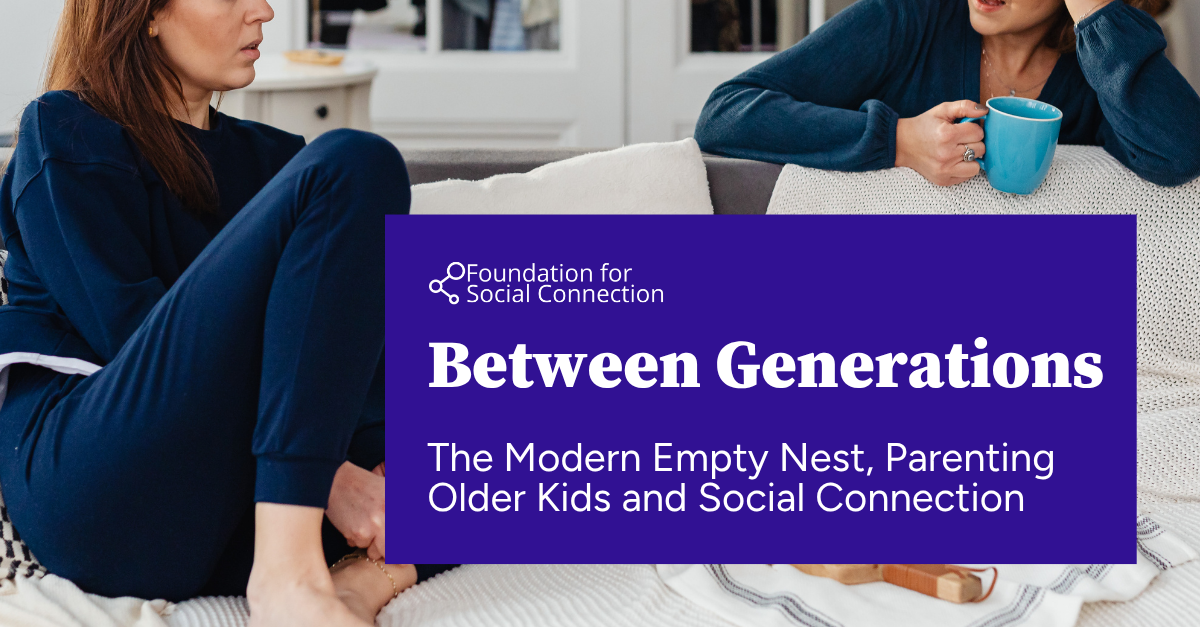
Sitting in a circle in a cozy living room, we explored what it means to be a so-called empty nester – the daily reality, the challenges, and the upsides. We represented a wide range of life situations: married and single; living alone and in multigenerational homes; working full-time, part-time, retired, and “in between” or experimenting. However, we almost immediately agreed the term “empty nester” – a label defined by loss, an absence – didn’t sit right. It was hardly inspirational. Worse, it failed to reflect how the demands and trends of modern parenting shaped our daily lives and the experiences of so many families, especially as more households become multigenerational.
Several people described the challenge of rebuilding connection, but their lives remained busy juggling work demands, remote or hybrid isolation, rising polarization, and financial responsibilities. Convenience, exhaustion, and habit made many of us unintentionally burrow into our homes, routines, and screens.
Some had children living far away, but close emotional bonds, technology, and social media made them still feel close. Others had children return home as adults, leaving some to navigate the intense experience of being a member of the sandwich generation – supporting their grown children while also caring for aging parents, relatives, or even grandchildren.
1. Social connection must be prioritized. “It’s harder to meet people as you get older,” a woman offered, and we all nodded. On top of facing the general decline in group membership and community participation that has occurred over the past few decades, many of us also had to grapple with losing built-in social networks from children’s school years. Whether reconnecting with friends and family, meeting new people, or simply getting out of our homes (and our comfort zones!) to interact with neighbors and community members, we all recognized the need to prioritize our relationships.
2. Meaning-making and identity-making is active, not passive. While life events launch us into this “empty nest” stage, we have the power to shape what this next chapter looks like and how we experience it. People shared how they’ve been experimenting — “throwing spaghetti at the wall,” as one person put it — by rediscovering hobbies, traveling, or even relocating. Others highlighted the importance of seeking out spaces where connection can naturally unfold. Intergenerational spaces — local Ys, churches, libraries, community centers, parks and other communal hubs — surfaced as particularly helpful places to meet people and feel a sense of purpose. (For those looking for more ideas, the Foundation’s SOCIAL Framework reports and Action Guide offer practical ways to increase meaningful connection.)
3. Mixed emotions are normal and valid. People voiced many different emotions about this period in their lives. Excitement, relief, curiosity, exhaustion, hope, to name a few. As one mom put it, “I almost miss the pile of shoes,” or another, “I miss my kids but am glad to have my space back.” Someone described it as a pause, another, a pivot. However, throughout our discussion, we all shared a feeling of uncertainty about what’s next – a sense that this stage of life feels fundamentally different than what past generations of parents might have experienced. Researchers have noted that raising Gen Z or young millennials has been part of a longer, more emotionally intense, hands-on phase of parenting. Some people in the group also wondered whether the combination of social fragmentation, competitive academic and career pressures, and changing norms has resulted in parents forming deeper bonds with children, while at the same time drifting from peer friendships. As parenting models shift, it is important to recognize that freedom, longing, curiosity, excitement and loss can and do often coexist – and it’s essential that we name them without judging or stigmatizing.
Honest conversations about the evolving experiences of parents and caregivers are long overdue. We are the bridge connecting the generations – and serve as the foundation for the health and well-being of many people in our families and communities. Today that load is heavy given the epidemic of loneliness and social disconnection that has so greatly impacted the health of our younger and older people. Parental mental health has also suffered. In a recent survey, nearly half of parents reported that on most days their stress is overwhelming, compared to about a quarter of other adults.
So, it’s high time to address their needs for connection and support. There’s much work to do in supporting people in this middle stage of life and better understanding how they can find connection while serving multiple generations in their families and larger communities.
Our group will meet again in January, a great month for a fresh start—a fresh nest, in a way. We’ll continue gathering monthly, centering each meeting around a timely topic supported by a few short readings or podcasts. I’m excited to launch this new small-group experience for empty nesters—inspired by the meaningful connections and growth in the parent groups I’ve led over the years. In those programs, I’ve seen that bringing parents together to learn, share, bond, and better navigate the demands of modern family life had immediate and lasting impacts. It can be very powerful when a small group has room to talk openly, compare experiences and learn from one another. All too often parents and caretakers don’t get the space (mentally or physically) to pause, breathe and be present – and to prioritize their own health and well-being. So this new group will create this much-needed space for people in the empty-nest stage to explore what this transition means for them – offering a supportive place to reflect on this next chapter and find renewed meaning, well-being and connection together.